Resonance
Beta Brainwaves and Focus: How 13–30Hz States of High-Alert Cognition Sharpen Intentional Thinking and Drive Manifestation Through Mental Precision
Quantress · April 23, 2026
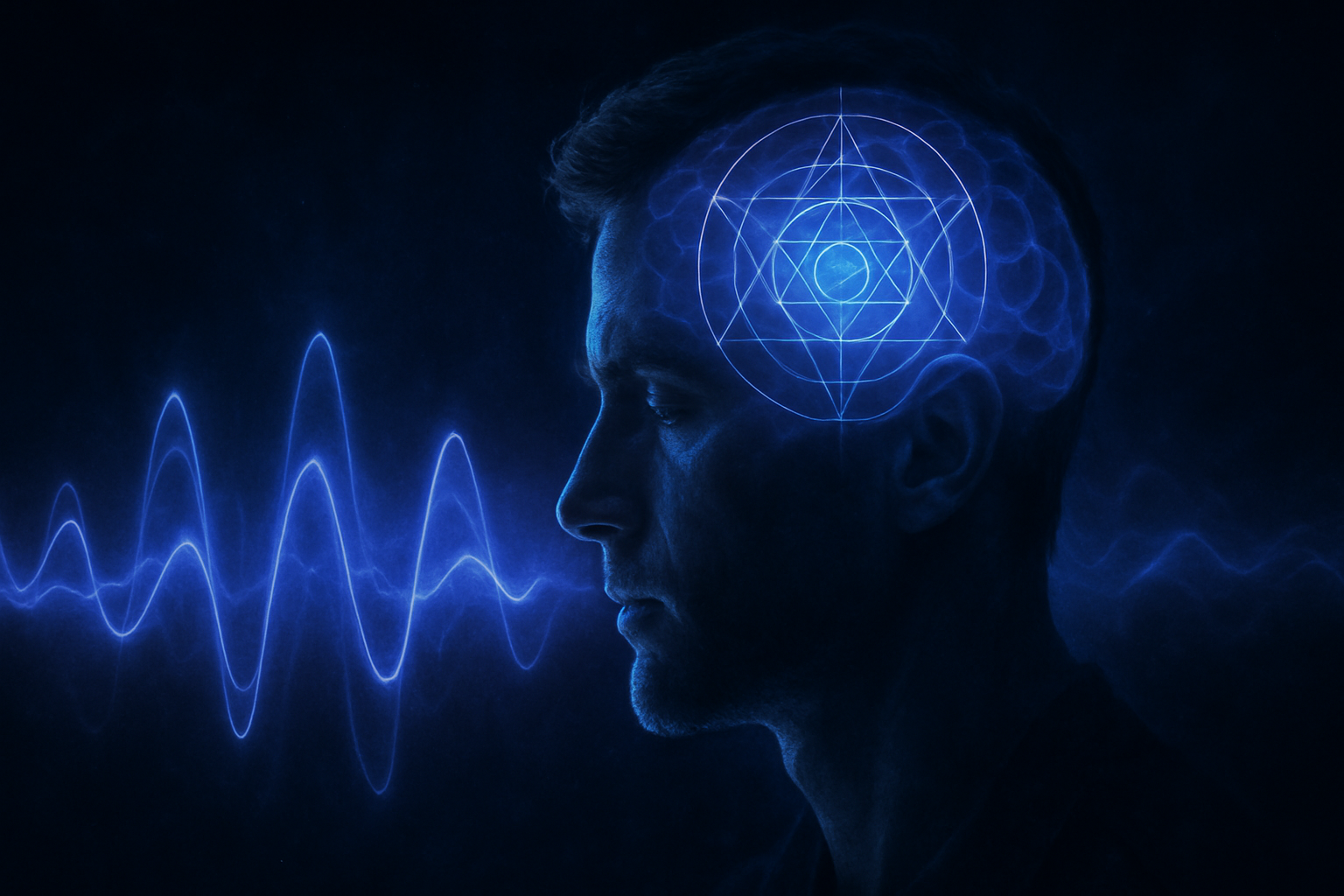
Beta brainwaves govern the alert, analytical mind — the state where deliberate intention is sharpest and cognitive direction is most potent. Understanding how to harness and regulate 13–30Hz activity may be the missing variable between scattered thinking and precise reality creation.
There is a particular quality of mind that athletes call "the zone," that musicians describe as flow, and that ancient contemplatives recognized as the state of purposeful, arrow-like attention. Modern neuroscience has given this state a precise frequency signature: beta brainwaves and focus are, in the deepest sense, two expressions of the same phenomenon. Operating between 13 and 30 Hz, beta oscillations are the electrical signature of a brain fully engaged with the world — alert, analytical, intentional. And yet, despite decades of EEG research, something about this frequency band still puzzles scientists: why does the same neural state that produces brilliant problem-solving also, under the right conditions, become the precise launching pad for what many traditions call conscious manifestation?
The answer, as with so many things at the frontier of consciousness science, lives at the intersection of neuroscience, quantum biology, and ancient wisdom. Understanding beta brainwaves is not merely an academic exercise. It is a practical map for anyone who wants to think with greater precision, act with greater intention, and bring the architecture of their inner world into coherent alignment with outer reality.
The Neuroscience of Beta: More Than Just "Busy Brain"
Beta waves are often dismissed in popular wellness culture as the "stress frequency" — something to be suppressed in favor of alpha or theta states. This is a profound oversimplification. Research published in NeuroImage and the Journal of Neuroscience has consistently demonstrated that beta oscillations play a critical role in working memory, cognitive flexibility, and the top-down regulation of attention. Far from being mere neural noise, beta rhythms are the brain's mechanism for maintaining active cognitive frameworks — holding a goal in mind while filtering out irrelevant information.
What makes beta particularly fascinating is its subdivision into three distinct sub-bands:
- Low Beta (13–16 Hz): Associated with relaxed, outward attention. This is the contemplative thinker's beta — present, calm, and gently focused. Ideal for creative problem-solving that still requires logical structure.
- Mid Beta (17–23 Hz): The workhorse of intentional cognition. This range correlates with active engagement, decision-making, and the kind of deliberate thinking that turns a vague desire into a concrete plan.
- High Beta (24–30 Hz): The edge territory — heightened alertness that, when disciplined, becomes razor-sharp clarity, but when unmanaged, tips into anxiety and cognitive fragmentation.
The distinction matters enormously for anyone working with manifestation practices. Intention — real, coherent intention — is not a dreamy alpha-state wish. It is a mid-beta cognitive event: clear, directed, emotionally charged, and structurally precise. The brain literally builds the scaffolding of your desired reality in beta.
Beta, Intention, and the Quantum Observer Effect
"The observer, when he observes, is not a passive witness. He participates in the creation of the observed."
— Werner Heisenberg, as interpreted across decades of quantum philosophy
Quantum mechanics introduced a radical idea into science: the act of conscious observation influences the behavior of subatomic particles. While the precise mechanisms remain debated, the implications for consciousness research are extraordinary. If attention itself is a form of energy that interacts with physical reality at the quantum level, then the quality of that attention — its coherence, its frequency, its intentional structure — becomes critically important.
This is precisely where beta brainwaves and focus intersect with manifestation science. Neurophysicist Karl Pribram's holonomic brain theory proposed that the brain processes reality through wave-interference patterns analogous to holographic projection. In beta states, the brain's wave interference becomes highly organized and directional. You are not merely thinking about a goal — you are, in a very literal electromagnetic sense, broadcasting a coherent signal. Research from the HeartMath Institute has shown that coherent brainwave states produce measurable electromagnetic fields that extend beyond the skull, influencing both biological and, in some studies, physical systems in the immediate environment.
Manifestation traditions from Hermetic philosophy to modern Law of Attraction frameworks have always insisted that clarity and precision of thought are non-negotiable prerequisites for conscious creation. Neuroscience now offers a mechanistic complement to this wisdom: when your brain is locked into coherent mid-beta, it is not metaphorically "sending out" an intention — it is generating a structured electromagnetic field pattern. Reality, at its most fundamental level, may be listening.
Practical Techniques: Cultivating Focused Beta for Intentional Manifestation
The goal is not to maximize beta activity indiscriminately — it is to cultivate coherent, purposeful beta states. Here are four techniques you can begin using immediately:
- Precision Journaling (15–20 minutes, morning): Write your intention not as a vague desire but as a specific, sensory-rich description of an already-achieved outcome. Use present-tense, declarative sentences. This forces the prefrontal cortex into high mid-beta engagement and begins training the brain to hold the intentional framework as a stable cognitive structure. Research on mental simulation published in Psychological Science confirms that vivid, detailed mental rehearsal activates the same neural pathways as actual execution.
- Beta-Entraining Sound Sessions: Binaural beats or isochronic tones in the 15–20 Hz range can gently guide the brain toward focused beta states. Listen through quality headphones while reviewing your written intention. The acoustic entrainment primes your neural oscillators, and the simultaneous review of your intention embeds the cognitive content into the entrained state — a powerful double anchor.
- The 4-7-8 Beta Bridge: Counterintuitively, a brief controlled breathing cycle (inhale 4 counts, hold 7, exhale 8) followed immediately by rapid, deliberate focus on a single task can spike productive mid-beta activity. The brief breath hold increases CO₂ tolerance and cerebral blood flow, creating the physiological substrate for heightened alertness without anxiety.
- Deliberate Attention Training (DAT): Choose a single object — a candle flame, a geometric shape, a written word. Hold your undivided visual and cognitive attention on it for exactly 5 minutes without redirection. This exercise, drawn from both Tibetan Samatha meditation and modern attention-training protocols, directly strengthens the neural circuits responsible for sustained beta oscillations. Do this daily for 21 days and observe the qualitative shift in your capacity for intentional thinking.
Sound Healing and Beta: The Resonance Bridge
Sound healing traditions have long worked with the principle that external vibration can reorganize internal states. In the context of beta brainwaves and focus, this becomes a powerful practical tool. Specific acoustic frequencies — particularly those incorporating sacred geometry ratios and resonant harmonics — appear to support the brain's capacity to maintain coherent beta oscillations without the energetic cost of self-generated effort.
Tibetan singing bowls, tuned to frequencies that create specific harmonic overtone series, have been studied for their effect on brainwave coherence. A 2018 study published in the Journal of Evidence-Based Integrative Medicine found that Tibetan sound meditation significantly reduced tension, anxiety, and fatigue — while participants reported increased mental clarity and focus, markers consistent with healthy, regulated beta activity.
Quantress users report that pairing focused intention-setting practices with specifically curated harmonic resonance soundscapes creates a synergistic effect — the sound environment holds the neural space open, reducing the cognitive effort required to maintain focus, and allowing the intentional content to register more deeply at both conscious and subconscious levels. Tools like Quantress leverage the science of harmonic resonance to create acoustic environments precisely calibrated to support these coherent beta states, bridging the gap between ancient sound wisdom and contemporary neuroscientific understanding.
The Disciplined Mind as Sacred Instrument
Every great wisdom tradition has insisted, in its own language, that a trained, focused mind is the primary instrument of creation. The Vedantic concept of dharana — concentrated attention — the Jesuit practice of discernment, the Hermetic principle of mentalism: all point to the same fundamental truth. The mind, operating with disciplined precision, is not merely a passive receiver of reality but an active participant in its construction.
Modern neuroscience, quantum biology, and consciousness research are slowly, rigorously, and beautifully confirming what mystics have always known. Beta brainwaves and focus are the neural signature of this sacred precision — the frequency at which human consciousness becomes most coherently creative, most intentionally powerful, most deeply aligned with the quantum field of infinite possibility.
Begin tonight. Write one sentence — precise, present-tense, sensory-specific — describing the reality you are choosing to create. Read it in a quiet room with a focused mind. Notice the quality of attention it requires. That quality, that electrical hum of directed awareness, is your beta state at work. Cultivate it. Refine it. Trust it. The universe, it turns out, responds most clearly to those who speak its language with precision and love.