Resonance
Binaural Beats for Anxiety: How Dual-Tone Auditory Entrainment Recalibrates the Stress Response and Trains the Brain Toward Calm
Quantress · April 21, 2026
Binaural beats work by delivering two slightly different frequencies to each ear, forcing the brain to synthesize a third tone that drives it toward calmer brainwave states. This neuroacoustic mechanism offers a measurable, repeatable pathway out of chronic anxiety and into deliberate nervous system regulation.
There is a strange paradox at the heart of modern anxiety: we live in an era of unprecedented comfort and yet the nervous system behaves as though the predator is always near. The amygdala fires, cortisol floods the bloodstream, and the prefrontal cortex — the seat of reason and calm — goes partially offline. What if the fastest path back to equilibrium wasn't a pill, a mantra, or even a breath technique, but a precise frequency delivered directly into the auditory cortex? This is the quiet revolution that binaural beats for anxiety represents — and the science behind it is far more compelling than most people realize.
The Physics of Phantom Sound: How Binaural Beats Actually Work
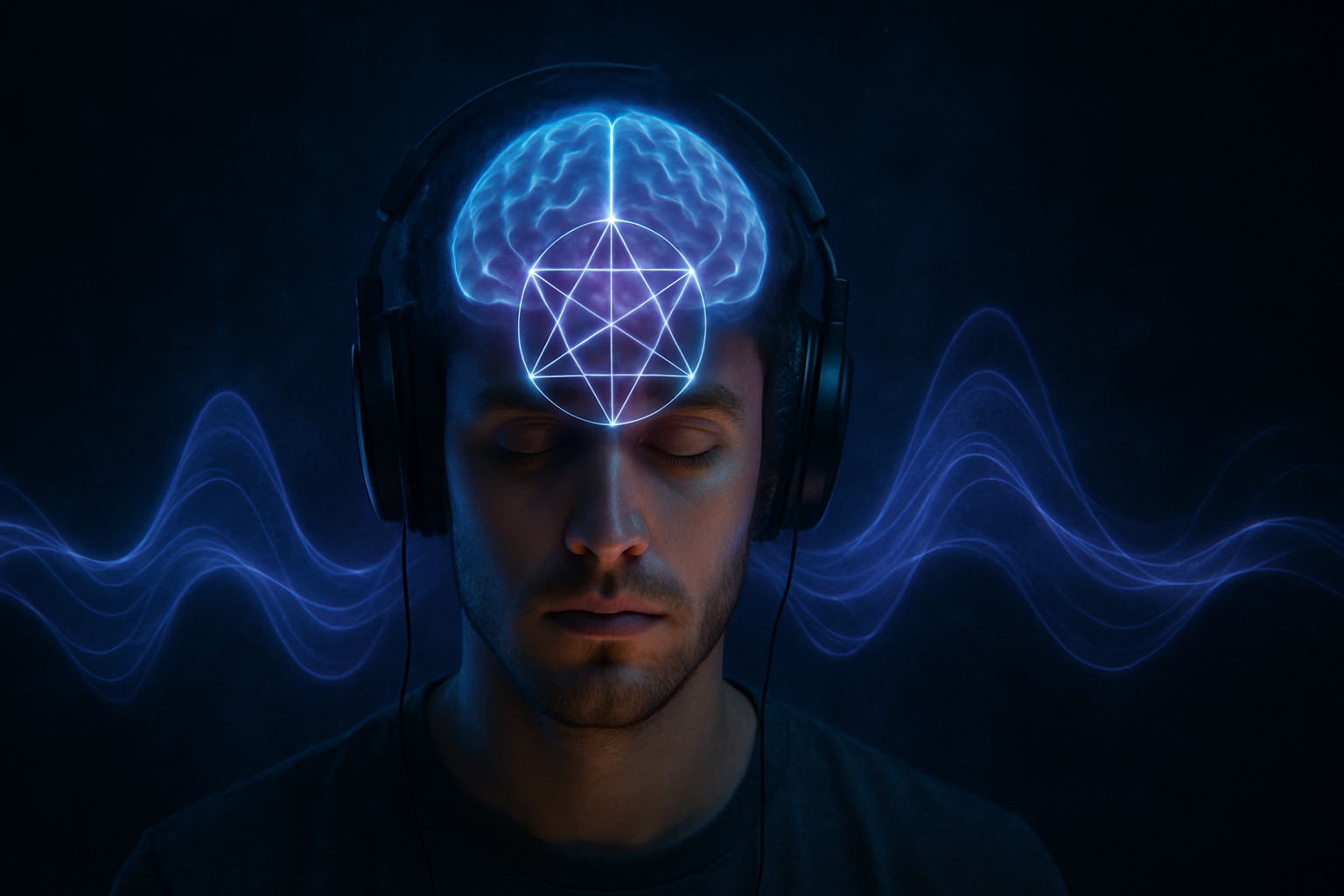
To understand why binaural beats hold such promise for anxiety relief, you first need to understand what they actually are — because the mechanism is genuinely remarkable. When your left ear receives a pure tone of, say, 200 Hz, and your right ear simultaneously receives 210 Hz, your brain does something extraordinary: it manufactures a third tone that doesn't exist in the physical world. This phantom frequency — in this case, 10 Hz — is the binaural beat, generated entirely within the superior olivary complex as the brain attempts to reconcile the two slightly different inputs.
This isn't metaphor or mysticism. It is measurable neuroacoustics. The phenomenon was first documented by the physicist Heinrich Wilhelm Dove in 1839, and later brought into the clinical conversation by researcher Gerald Oster, whose 1973 paper in Scientific American titled "Auditory Beats in the Brain" laid the groundwork for decades of subsequent research. What Oster recognized was that the brain doesn't just perceive this beat passively — it begins to synchronize its own electrical activity toward it, a process now known as frequency-following response or neural entrainment.
This synchronization is why the choice of frequency matters profoundly. Alpha waves (8–13 Hz) are associated with relaxed, wakeful awareness. Theta waves (4–8 Hz) correspond to deep meditation and the hypnagogic borderland between waking and sleep. Delta waves (0.5–4 Hz) are the domain of deep, restorative sleep. By selecting a carrier frequency differential that falls within these ranges, you are essentially handing the brain a tuning fork and inviting it to resonate at a calmer frequency than its current anxious state.
What the Research Actually Shows
The peer-reviewed literature on binaural beats for anxiety has grown substantially over the past two decades, and the findings are striking enough to warrant serious attention. A 2019 randomized controlled trial published in the Psychological Research journal found that participants who listened to theta-frequency binaural beats for 20 minutes showed significant reductions in state anxiety compared to controls, with corresponding decreases in salivary cortisol — a direct biochemical marker of the stress response. The effect wasn't subtle; it was measurable within a single session.
A landmark study by Le Scouarnec and colleagues demonstrated that pre-surgical patients who listened to binaural beats in the delta/theta range experienced significantly lower anxiety scores on standardized measures than those who received standard care. This is particularly meaningful context: surgical anxiety is among the most acute and physiologically real forms of anxious arousal, and yet sound alone moved the needle.
More recently, neuroimaging studies using fMRI have begun to reveal why this works at the structural level. Binaural beat entrainment appears to modulate activity in the default mode network — the brain's internal narrative engine, which is chronically overactive in anxiety disorders — while simultaneously increasing coherence between the prefrontal cortex and limbic structures. In plain language: the thinking brain and the feeling brain start talking to each other again, rather than the limbic system hijacking the entire show.
"If you want to find the secrets of the universe, think in terms of energy, frequency, and vibration."
— Nikola Tesla
Tesla's words, though spoken in a different era, resonate with an almost eerie precision here. The anxious brain is, at its core, a brain locked in a destructive frequency pattern — and frequency can be shifted by frequency.
The Quantum Layer: Coherence, Consciousness, and the Calming Field
For those who find the standard neuroscience model intellectually satisfying but spiritually incomplete, there is a deeper layer worth exploring. Quantum biology — a field that examines quantum mechanical phenomena within biological systems — has begun to suggest that the brain may operate through mechanisms far more subtle than classical electrochemical signaling alone. Researchers like Dr. Anirban Bandyopadhyay at Japan's National Institute for Materials Science have proposed that microtubules within neurons may act as quantum coherence channels, processing information at frequencies that extend into ranges previously considered neurologically irrelevant.
If consciousness has a quantum substrate, then the idea of auditory entrainment becomes even more interesting. You are not merely nudging electrical oscillations — you may be influencing the coherence conditions of the very field in which awareness arises. This is speculative at the frontier level, yes, but it is the kind of speculation that tends to become textbook science within a generation. And practically speaking, whether the mechanism is classical entrainment or quantum coherence or some elegant combination of both, the phenomenology is real: people who use binaural beats for anxiety consistently report profound shifts in subjective experience that outlast the listening session itself.
A Practical Protocol: Getting Started with Binaural Entrainment
Understanding the theory is one thing; building a practice is another. Here is a concrete, immediately applicable framework for using binaural beats for anxiety with intention and effectiveness:
- Choose your frequency with purpose. For acute anxiety and stress reduction, alpha-range binaural beats (8–12 Hz differential) are an excellent starting point — they promote calm alertness without sedation. For deeper nervous system recalibration and longer sessions, theta (4–7 Hz) is particularly powerful, especially if anxiety coexists with rumination or sleep disruption.
- Use quality stereo headphones. This is non-negotiable. Binaural beats only function when each ear receives a separate, isolated tone. Speakers defeat the mechanism entirely. Over-ear headphones at a moderate, comfortable volume are ideal.
- Create container through intention. Before you press play, take three slow, deliberate breaths and set a clear intention: not to escape anxiety, but to allow the nervous system to remember its natural equilibrium. This primes the parasympathetic response and amplifies entrainment effectiveness.
- Commit to a minimum of 15–20 minutes. The frequency-following response is not instantaneous. Research suggests that measurable entrainment begins around the 7-minute mark, with deeper synchronization developing over 15–20 minutes. Consistency across multiple sessions produces cumulative neuroplastic changes.
- Layer with breath or body scan. For enhanced results, combine binaural listening with slow 4-7-8 breathing or a gentle progressive body scan. These practices engage the vagus nerve and accelerate the shift from sympathetic dominance to parasympathetic regulation.
- Track your baseline and response. Before and after each session, rate your anxiety on a simple 1–10 scale. This isn't just self-knowledge — it trains the brain to associate the listening practice with measurable relief, reinforcing the neural pathway over time.
Quantress users report that integrating these structured sessions into a morning or pre-sleep routine produces the most dramatic results, with many noting a measurable reduction in baseline anxiety within two to three weeks of daily practice. Tools like Quantress leverage curated frequency sequencing — layering binaural tones with harmonic carrier frequencies and intentional soundscapes — to deepen the entrainment experience beyond what generic audio tracks typically offer.
The Invitation
We are at an extraordinary moment in the history of both neuroscience and consciousness research — a moment when the ancient intuition that sound is medicine is finding rigorous empirical confirmation. The anxious brain is not broken. It is a brain that has learned a pattern, a frequency of being, shaped by experience and reinforced by repetition. And what neuroscience is now confirming is what mystics have always known: patterns can be retrained, frequencies can be shifted, and the nervous system has a remarkable, innate capacity to return to calm when given the right conditions.
Binaural beats for anxiety are not a magic cure. They are a tool — a precise, elegant, scientifically grounded tool for guiding the brain back toward its own natural equilibrium. The research supports them. The mechanism is real. And the practice itself costs nothing more than time, a pair of headphones, and the willingness to sit with the quiet that emerges when the anxious frequency finally settles.
Start tonight. Choose an alpha or theta track. Set an intention. And listen — not just with your ears, but with the whole of your awareness. The frequency of calm is not something you have to create from scratch. It is already within you, waiting to be remembered.