Brainwaves
How to Use Binaural Beats for Focus: A Step-by-Step Protocol
Quantress Team · June 26, 2026
A neuroscience-backed protocol for using binaural beats to enter deep focus — the right frequency band, volume, session length, and what to do before pressing play.
Focus is not a personality trait. It is a brain state — and like any state, it can be engineered. Binaural beats in the Beta (13–30 Hz) and lower Gamma (30–40 Hz) bands have been shown to nudge the brain toward sustained attention, faster task initiation, and reduced mind-wandering. This guide is the exact protocol we recommend at Quantress.
The neuroscience: why Beta and Gamma waves matter for focus
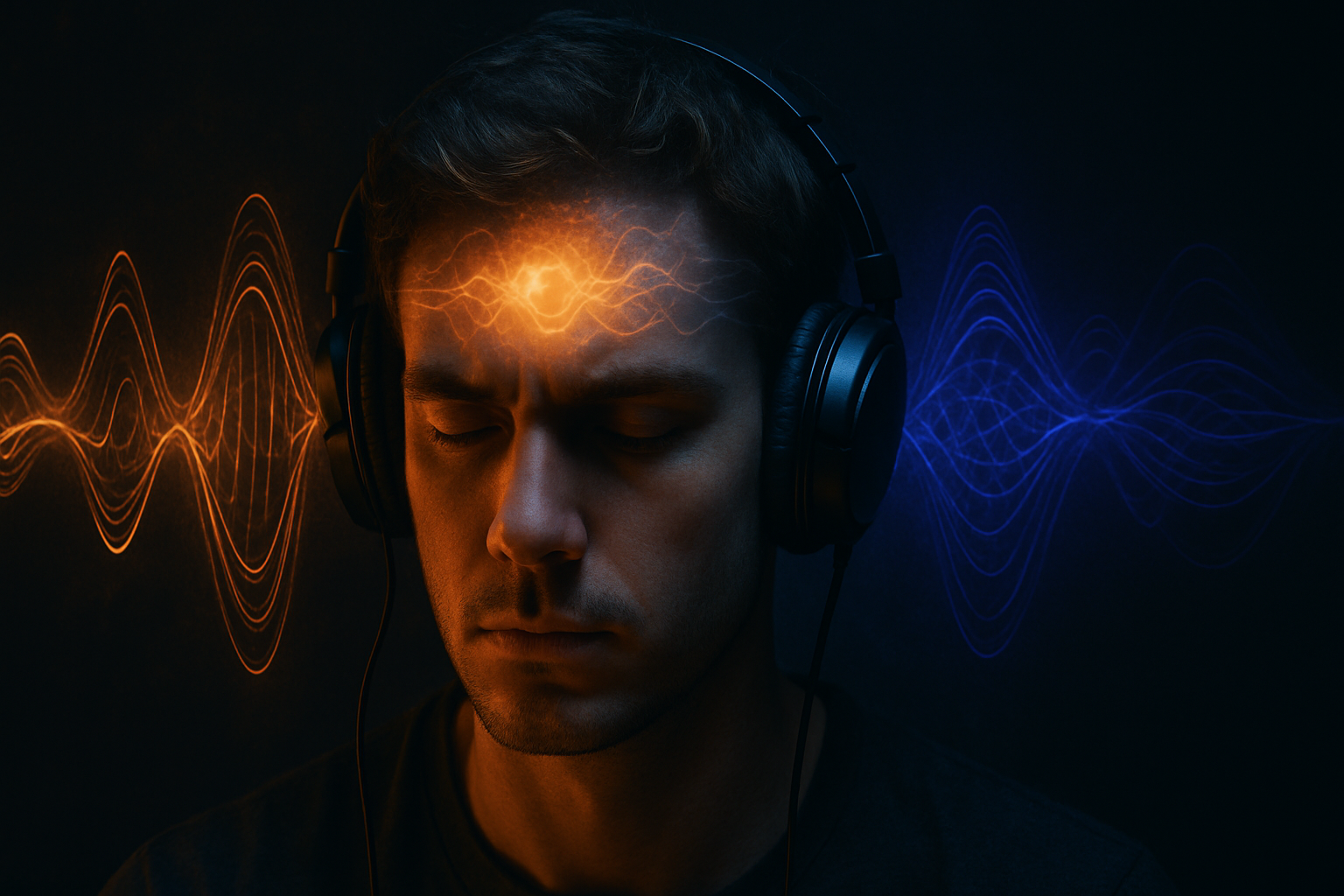
EEG research consistently associates Beta activity with alert, task-positive cognition and Gamma with higher-order integration — the "binding" of attention to a single object. When you deliver two tones with a difference equal to a target frequency (e.g. 200 Hz left, 215 Hz right = 15 Hz Beta beat), the brain's frequency-following response gradually entrains in that direction.
The effect is not magic and not instant. It is a nudge — a clean, repeatable bias toward the state you want, layered on top of your own intent.
Step 1 — Pick the right frequency band for the task
- Low Beta (13–18 Hz) — administrative work, email, code reviews, structured study.
- Mid Beta (18–25 Hz) — deep work, writing, problem solving, exam prep.
- Gamma (30–40 Hz) — high-stakes integration: complex analysis, strategy, creative synthesis.
Skip Alpha and Theta tracks for focus sessions. They are excellent for relaxation and creativity ideation, but they actively work against the alert state you want for execution.
Step 2 — Optimal listening volume
Low. Always low. The entrainment is driven by the frequency difference between the two ear channels, not by sound pressure. Set the volume just above the threshold where the carrier tones are clearly perceptible. If the audio competes with your thinking, it's too loud.
A useful test: if you can hear the rhythm of your own breath over the audio, you're at the right level.
Step 3 — Session duration for maximum effect
The entrainment response builds gradually. Most users feel the shift within 7–12 minutes, with full effect around the 20-minute mark. Practical session lengths:
- 25 minutes — single Pomodoro-style focus block. Recommended default.
- 50 minutes — one extended block for deep work. Take a real 10-minute break after.
- 90 minutes — one ultradian cycle. Maximum recommended single sitting.
Avoid back-to-back Beta sessions longer than 2 hours total. Sustained Beta entrainment without recovery raises perceived tension. Alternate with a short Alpha track or silence between blocks.
Step 4 — The 60-second pre-session ritual
Binaural beats work best when your brain isn't already half-committed to ten other things. Before pressing play:
- Close every tab and notification you're not actively using.
- Write the single task for this session on paper. One sentence. No list.
- Put your phone in another room or in a drawer.
- Take three slow breaths before the audio starts.
This 60 seconds doubles the perceived effect because it removes the friction that normally fragments attention in the first 10 minutes.
Step 5 — Headphones are non-negotiable
Binaural beats are created inside the brain when each ear receives a different frequency. Speakers send both tones to both ears and the effect collapses. Use stereo headphones or earbuds every single time. Wired or wireless both work; bone conduction works if it delivers true separated channels.
How long until you feel a difference?
A single session produces a noticeable but short-lived boost. The compounding benefits — faster focus onset, fewer false starts, lower distractibility baseline — show up after 5 to 14 consecutive days of daily use. Treat it like cardio training, not caffeine.
Common mistakes that kill the effect
- Listening on speakers or a single earbud.
- Volume so loud the tones fatigue your ears within 10 minutes.
- Switching tracks mid-session — entrainment restarts every time.
- Using a Theta or Delta track and wondering why focus didn't improve.
- Expecting day-one results and quitting on day three.
FAQ
What is the best binaural beat frequency for focus?
14–18 Hz (low-to-mid Beta) for most knowledge work. 30–40 Hz (Gamma) for complex integration tasks. Start with Beta — Gamma is more demanding and not the right baseline.
Can I listen to binaural beats while working?
Yes — that's the point. Keep the volume low so the audio sits underneath your thinking, not on top of it. Avoid lyrics; use pure-tone or ambient focus tracks.
Are binaural beats safe for daily use?
For healthy adults, yes. Avoid if you have a history of seizures or active inner-ear conditions. They are not a substitute for clinical care.
How is this different from focus music or lo-fi?
Lo-fi and focus playlists rely on masking and pleasant background — they reduce distraction. Binaural beats add an active EEG-entrainment signal on top of that. Many of our focus tracks layer both.
Quantress audio is a wellness and productivity tool. It does not replace professional medical, psychological, or psychiatric care.