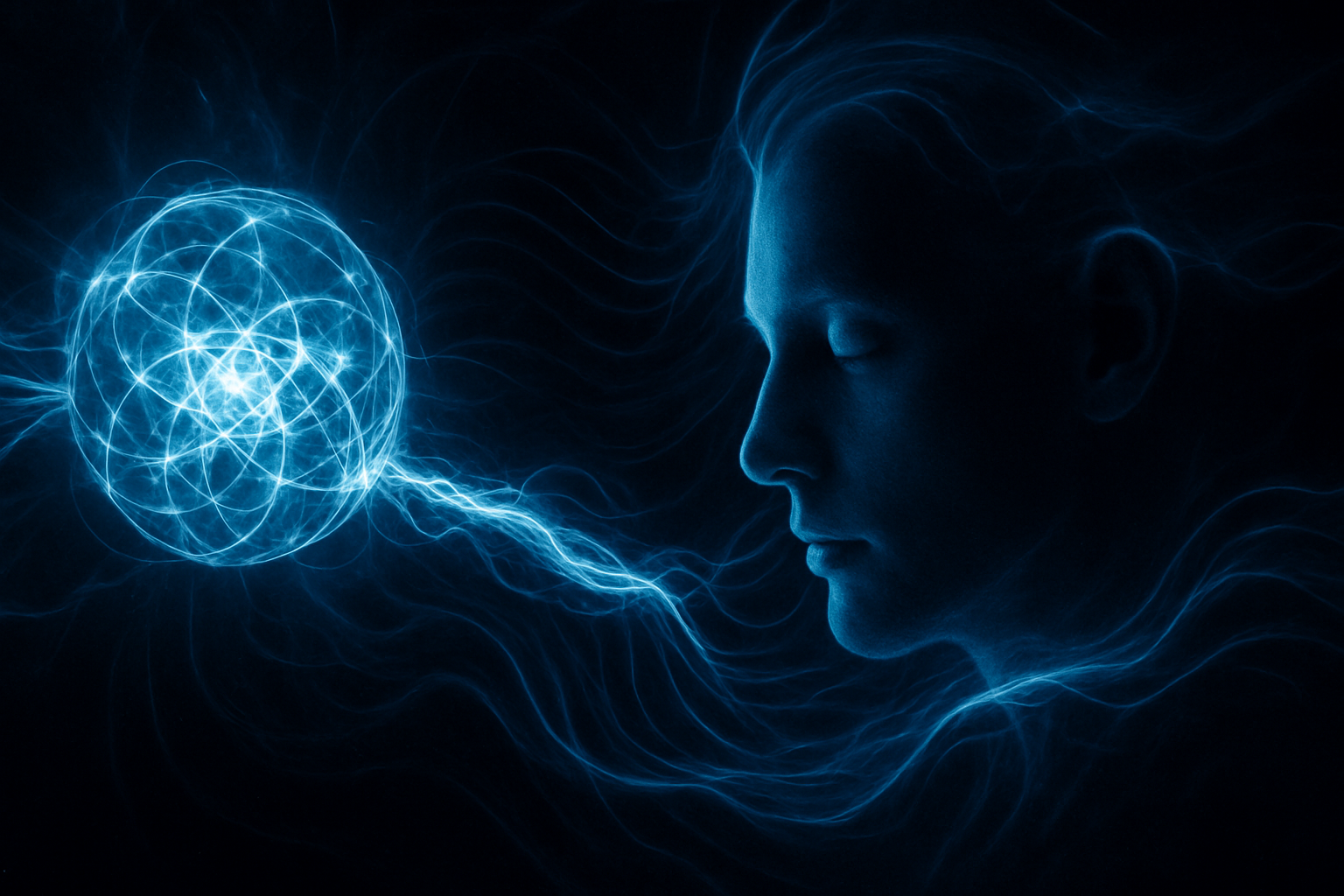
Quantum
Quantum Entanglement and Consciousness: How Non-Local Mind Connections May Be the Hidden Mechanism Behind Manifestation
Quantress · March 23, 2026
Quantum entanglement suggests that particles can influence each other across vast distances with no physical connection — and new theories propose your consciousness may operate the same way. This article explores how non-local mind connections could explain intuition, collective manifestation, and the invisible threads linking intention to reality.
Something strange happens when two particles become entangled. Measure one, and the other — no matter how far away — instantly reflects the change. No signal. No delay. No physical connection we can trace. Einstein called it "spooky action at a distance" and spent years trying to explain it away. Decades later, the experiments of Alain Aspect and his successors confirmed: the spookiness is real. And increasingly, a growing body of theoretical physicists, neuroscientists, and consciousness researchers are asking a question that once seemed too wild to voice in academic circles — what if the human mind operates by the same principle?
The intersection of quantum entanglement and consciousness is no longer the exclusive territory of fringe thinkers. It sits at the bleeding edge of neuroscience, quantum biology, and what some are calling manifestation science — the rigorous investigation of how intention, attention, and belief appear to influence physical reality in ways that classical physics cannot fully explain. This article explores the evidence, the mechanisms, and — crucially — how you can begin working with these principles right now.
The Science of Non-Local Mind: What the Research Actually Says
In quantum physics, non-locality refers to the phenomenon where entangled particles influence each other instantaneously across any distance. This violates our intuitive sense of space and time, yet it has been rigorously confirmed in laboratory settings. The 2022 Nobel Prize in Physics was awarded to Aspect, Clauser, and Zeilinger specifically for their work proving the reality of quantum entanglement — a milestone that sent quiet tremors through consciousness research communities worldwide.
The provocative question is this: does the brain leverage quantum processes, and if so, do those processes extend beyond the skull? The most well-known framework for quantum consciousness is the Orchestrated Objective Reduction (Orch OR) theory, developed by physicist Sir Roger Penrose and anesthesiologist Stuart Hameroff. Their model proposes that quantum computations occurring within microtubules — protein structures inside neurons — give rise to conscious experience. While Orch OR remains debated, a 2022 study published in Physics of Life Reviews presented updated experimental support for quantum vibrations in microtubules, lending new credibility to the idea that biological tissue can sustain quantum coherence far longer than previously assumed.
Even more striking is work in the field of quantum biology, which has demonstrated quantum coherence in photosynthesis, bird navigation via the cryptochrome molecule, and enzyme catalysis. If photons can maintain entangled states within living biological systems, the theoretical door opens to the possibility that consciousness itself — or at least its substrate — participates in non-local information exchange.
"The day science begins to study non-physical phenomena, it will make more progress in one decade than in all the previous centuries of its existence."
— Nikola Tesla
Entanglement as the Hidden Mechanism Behind Manifestation
Manifestation — the idea that conscious intention can influence outcomes in physical reality — has historically been dismissed by mainstream science. But the intersection of quantum entanglement and consciousness offers something new: a mechanistic hypothesis for how this could work.
Consider the observer effect. In quantum mechanics, the act of measurement collapses a wave function — a field of probability — into a definite state. Many interpretations of quantum theory, from the Copenhagen interpretation to Wheeler's participatory universe, suggest that observation itself is not passive. The observer participates in collapsing possibility into actuality. If consciousness is genuinely quantum in nature, then sustained, coherent attention may not simply notice reality — it may participate in constructing it.
Dean Radin, Chief Scientist at the Institute of Noetic Sciences, has conducted decades of double-blind experiments suggesting that human intention can measurably influence quantum random event generators — devices that produce truly random outputs based on radioactive decay. His meta-analyses, published in peer-reviewed journals including Frontiers in Human Neuroscience, show small but statistically significant effects of mind on matter. Critics contest the interpretation, but the data refuses to disappear.
The working model emerging from this research is elegant: if consciousness operates through quantum processes, and quantum processes are inherently non-local and interconnected, then a sufficiently coherent, intentional mind may be capable of entangling with the quantum probability fields of desired outcomes — nudging the collapse of possibility toward specific realities. This is not magic. It is, potentially, physics we don't yet fully understand.
Practical Techniques: Cultivating Quantum Coherence in Your Consciousness
Whether or not every theoretical detail is eventually confirmed, the practical implications of this framework are immediately actionable. The key concept is coherence — a state in which quantum systems maintain phase alignment and can therefore exert coordinated influence. In terms of consciousness practice, coherence translates to mental clarity, emotional alignment, and focused intention. Here is how to cultivate it:
- Coherent Breathing with Tonal Anchoring: Breathe at a rate of approximately 5 breaths per minute (inhale for 5 seconds, exhale for 5 seconds). Research from HeartMath Institute links this rhythm to heart rate variability coherence, a measurable state associated with reduced cortisol and improved cognitive function. Pair this with a sustained vocal tone — humming at a comfortable pitch — to add a vibrational layer that supports neural entrainment.
- Entanglement Visualization: During meditation, visualize a golden thread of light connecting your heart center to the specific outcome, person, or state you wish to draw toward you. Rather than forcing or grasping, practice resonant presence — feeling as though the connection already exists, as if entanglement has already occurred. This mirrors the quantum principle that entangled particles do not communicate; they are simply already correlated.
- Frequency-Specific Sound Exposure: Research into brainwave entrainment suggests that binaural beats and specific sound frequencies can shift neural oscillation patterns. Gamma-range frequencies (around 40 Hz) have been associated in studies at MIT with synchronized neural activity and heightened perceptual awareness — states that may support the kind of coherent consciousness that quantum models predict would be most influential.
- Intention Setting at Liminal States: The hypnagogic state — the threshold between waking and sleep — is characterized by heightened theta brainwave activity and reduced filtering by the prefrontal cortex. Many traditions across history have identified this as a gateway state. Setting clear, emotionally charged intentions at this threshold may exploit the brain's natural quantum-like plasticity during low-coherence filtering windows.
The Non-Local Mind in Relationship: Connecting Across Distance
One of the most personally compelling implications of the quantum entanglement and consciousness hypothesis is its potential explanation for non-local relational experiences — the mother who wakes moments before her child calls from across the world, the sudden, wordless knowing that a loved one is in distress. Parapsychology researcher Rupert Sheldrake has catalogued thousands of such cases and designed controlled experiments around telephone telepathy and the sense of being stared at, publishing findings that consistently exceed chance in peer-reviewed literature.
From a quantum entanglement perspective, deep emotional bonds may create genuine entanglement-like correlations between the consciousness fields of two individuals. This is speculative — but it is scientifically coherent speculation, grounded in the known behavior of entangled quantum systems. Two minds that have been in sustained resonance — through love, shared trauma, deep meditation together, or even regular sound healing practice — may maintain a form of non-local correlation that allows information or emotional states to transfer instantaneously.
This reframes prayer, distant healing, and collective intention not as wishful thinking but as potential applications of non-local consciousness technology that humanity has been practicing intuitively for millennia, waiting for the physics to catch up.
Quantress users who engage in paired harmonic resonance sessions — using synchronized frequencies with a partner — frequently report heightened states of emotional attunement and what many describe as a felt sense of merging or shared field awareness. Whether interpreted spiritually or through the lens of emerging quantum biology, the phenomenology is remarkably consistent.
Begin Your Experiment Today
Science advances through experiment, and consciousness research is no different — except that you are both the scientist and the laboratory. The framework of quantum entanglement and consciousness invites you to take your inner life seriously as a causal force, not merely an effect. It suggests that the quality of your attention, the coherence of your emotional state, and the clarity of your intention are not soft variables — they may be the very instruments through which non-local mind reaches into the quantum substrate of reality and participates in the architecture of what becomes.
Start tonight. Breathe slowly. Hum a tone. Set an intention at the edge of sleep. And pay attention to what returns to you — not with grasping, but with the quiet confidence of someone who understands that they were never truly separate from what they seek.
The universe may not simply be observed by consciousness. It may be, in some profound and measurable sense, made of it.