Quantum
Quantum Entanglement and Consciousness: Are Human Minds Nonlocally Connected?
Quantress · February 27, 2026
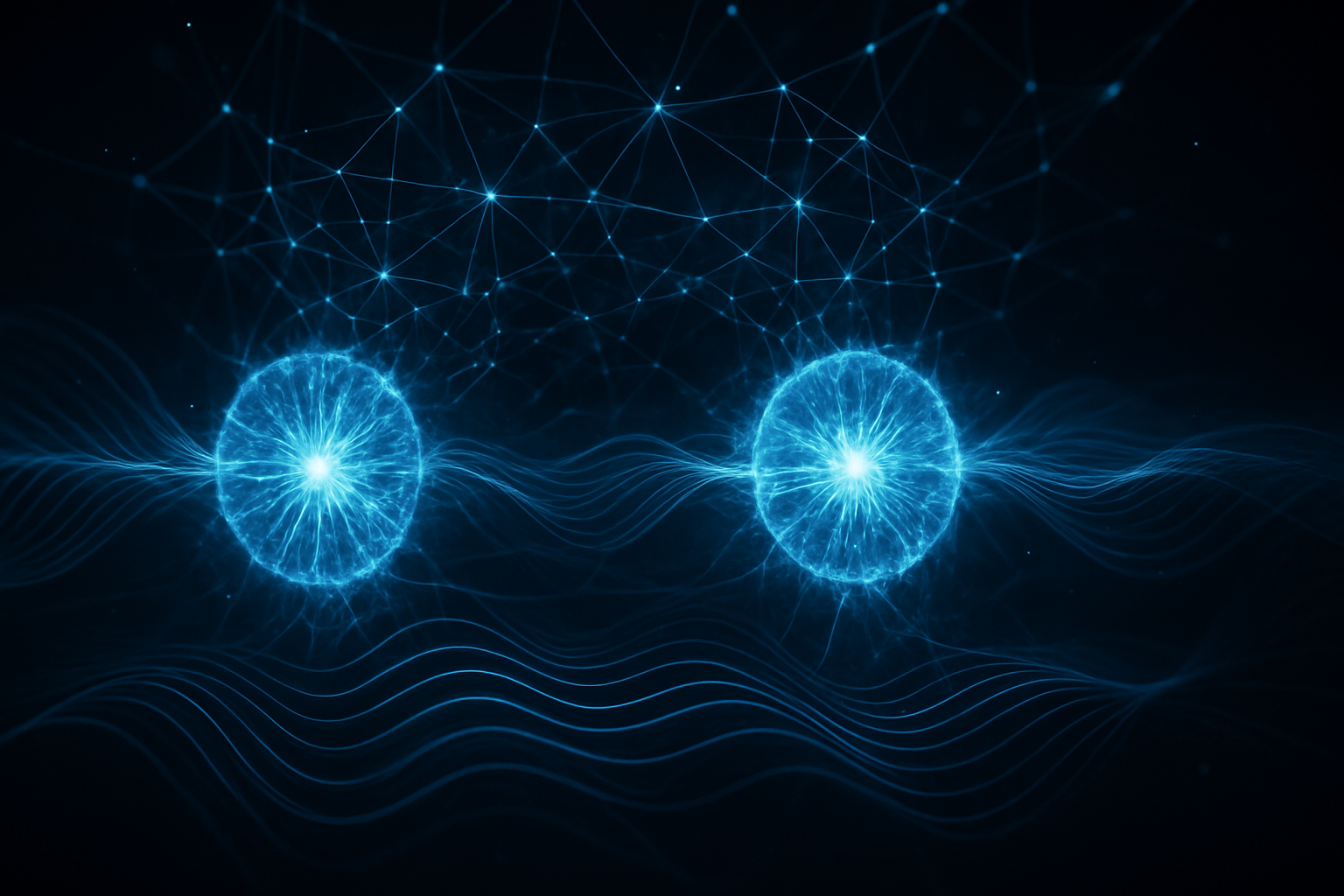
Quantum entanglement — Einstein's 'spooky action at a distance' — may hold the key to understanding how human consciousness transcends the boundaries of the individual brain. Explore the emerging science suggesting our minds may be nonlocally linked through the quantum field.
Imagine two particles, separated by the entire breadth of the universe, yet responding to each other instantaneously — as if distance were nothing more than an illusion. This is not science fiction. This is quantum entanglement, one of the most experimentally verified and philosophically unsettling phenomena in modern physics. And now, a growing body of researchers, neuroscientists, and consciousness explorers are asking a question that would have seemed absurd just decades ago: could quantum entanglement consciousness be more than a metaphor? Could human minds actually be nonlocally connected — not through mystical speculation, but through the very fabric of quantum reality?
The implications are staggering. If consciousness participates in quantum processes, then the boundaries we draw between "self" and "other," between "here" and "there," may be fundamentally less solid than our everyday experience suggests. This article explores the science, the philosophy, and — most importantly — the practical tools you can use to begin exploring nonlocal consciousness for yourself.
The Physics of Entanglement: What Science Actually Says
Quantum entanglement occurs when two or more particles interact in such a way that the quantum state of each cannot be described independently of the others, regardless of the distance separating them. Measure one particle's spin, and its entangled partner — even light-years away — will instantly reflect a correlated state. Einstein famously called this spukhafte Fernwirkung, "spooky action at a distance," and spent years trying to disprove it. He failed. The landmark 2015 loophole-free Bell test experiments conducted at Delft University confirmed what the equations had long predicted: nonlocal correlations are real.
But here is where the conversation deepens. Classical neuroscience treats the brain as a sophisticated biological computer — electrochemical signals, synaptic firings, neural networks. Consciousness, in this view, is a product of physical complexity. Yet some physicists and neuroscientists argue this picture is incomplete. The Orchestrated Objective Reduction (Orch OR) theory, proposed by physicist Sir Roger Penrose and anesthesiologist Stuart Hameroff, suggests that quantum processes within microtubules — protein structures inside neurons — may be integral to conscious experience. While Orch OR remains controversial, it opened a legitimate scientific conversation about quantum entanglement consciousness that has not closed since.
"Consciousness is not something that happens inside the brain. It is something that happens, and the brain participates in it." — Bernardo Kastrup, philosopher and former CERN researcher
More recently, a 2023 study published in Physics of Life Reviews found evidence that quantum coherence in biological systems persists far longer than previously thought possible — even at warm, wet temperatures like those found in the human body. This challenges the old objection that the brain is "too warm and noisy" for quantum effects to matter. The boundary between quantum physics and biology is dissolving, and consciousness sits squarely at that frontier.
Nonlocal Mind: Evidence from Parapsychology and Neuroscience
If quantum processes underlie consciousness, then nonlocal connections between minds become at least theoretically plausible. And intriguingly, experimental evidence — though still contested — keeps accumulating. The Global Consciousness Project at Princeton University has been running since 1998, monitoring a worldwide network of random number generators for statistically significant deviations during major collective human events. The data, spanning over two decades, shows consistent anomalies during moments of global emotional coherence — events like September 11, 2001, or New Year's celebrations.
Researcher Dean Radin at the Institute of Noetic Sciences (IONS) has conducted hundreds of double-blind experiments exploring phenomena like presentiment (physiological responses to stimuli before they occur) and mind-matter interaction. His meta-analyses, published in peer-reviewed journals including Frontiers in Human Neuroscience, report effect sizes that are small but statistically robust — far beyond what chance would predict. Radin has argued that quantum entanglement provides a physically plausible mechanism for these observations.
These findings do not "prove" that minds are entangled in the technical quantum sense. But they suggest that the standard model of consciousness — isolated, skull-bound, strictly local — may be missing something fundamental. The science invites us to remain open, curious, and willing to experiment.
Practical Techniques for Exploring Nonlocal Consciousness
You do not need a laboratory to begin exploring the edges of your own consciousness. These practices, drawn from contemplative traditions and supported by emerging research, can help you directly investigate the possibility of nonlocal connection.
- Heart-Brain Coherence Meditation: Research from the HeartMath Institute shows that when the heart and brain enter a state of coherence — measured through heart rate variability — individuals report heightened intuition and a sense of expanded awareness. To practice: breathe slowly and rhythmically at a rate of five seconds in, five seconds out. Simultaneously hold a genuine feeling of appreciation or love. Do this for ten to fifteen minutes daily. Coherence is the precondition for subtle perceptual sensitivity.
- Synchronized Intention Practice: Choose a partner — ideally someone you feel emotionally connected to — and agree on a specific time to simultaneously focus loving or healing attention on each other, without communication. Keep a journal of any impressions, emotions, or physical sensations during these windows. Over weeks, patterns often emerge that are difficult to explain through coincidence alone.
- Sound as a Quantum Bridge: Specific sound frequencies, particularly those associated with Solfeggio tones and binaural beats in the theta range (4–8 Hz), have been shown in EEG studies to synchronize neural oscillations and induce states associated with expanded awareness and reduced self-referential thought. Tools like Quantress leverage precision-tuned harmonic frequencies designed to guide the brain into these receptive states — and users consistently report experiences of deep interconnectedness and what feels like genuine nonlocal awareness during extended listening sessions.
- Mindful Observation of Synchronicity: Carl Jung coined the term synchronicity for meaningful coincidences that defy causal explanation. Begin keeping a dedicated synchronicity journal. As you increase your attentional sensitivity — through meditation, sound work, or coherence practices — you may notice that these events increase in frequency. Whether they reflect genuine nonlocal processes or heightened pattern recognition (or both), tracking them builds a personal evidence base that is irreplaceable.
The Philosophical Horizon: What Nonlocal Consciousness Would Mean
Let us sit with the full weight of this possibility. If human consciousness is genuinely nonlocally connected — even partially, even subtly — then several things follow that have enormous practical and ethical implications.
First, compassion becomes physics. The suffering of another person would not be merely a moral concern but a literal resonance phenomenon — a disturbance in a field you participate in. Traditions from Buddhism to Sufism to Indigenous wisdom have always known this. Quantum theory may be providing the mathematical scaffolding for what mystics experienced directly.
Second, intention becomes consequential in new ways. If your conscious state influences a shared field — even at the margins of statistical significance — then the quality of attention you bring to your daily life matters beyond your personal experience. Group meditation studies, including a famous series in Washington D.C. in 1993, reported measurable reductions in violent crime during periods of large-scale coherent group meditation. The effect sizes were controversial but statistically significant according to peer review.
Third, and perhaps most profoundly, the isolated self may be the illusion, not the connection. Quantum entanglement consciousness research points toward a model of mind that is more like a localized expression of a deeper, unified field than a discrete, independent entity. This is precisely what nondual contemplative traditions have pointed to for millennia — the experience of individual awareness arising within, and as an expression of, something boundless.
Begin Your Own Investigation
The most important thing science has taught us is that reality consistently exceeds our models of it. Quantum entanglement was once considered impossible, then theoretical, then proven. The relationship between quantum processes and consciousness is at that exact inflection point right now — somewhere between theoretical and demonstrated, waiting for the experiments and the experiencers who will clarify the picture.
You are in a unique position. You exist at the intersection of an extraordinary scientific moment and an ancient contemplative lineage that has always known the mind extends beyond the skull. Start with the practices above. Cultivate coherence. Work with sound. Notice synchronicities. Share intentions with trusted others and compare notes. Keep a rigorous inner journal.
The universe entangled its particles across impossible distances and let them speak to each other without delay. Perhaps it did the same with minds. The only way to know is to pay exquisite attention — and begin.