Quantum
Quantum Entanglement and Consciousness: How Nonlocal Correlation Between Particles May Explain the Mind's Ability to Influence Reality at a Distance
Quantress · April 30, 2026
Quantum entanglement demonstrates that two particles can remain instantaneously correlated regardless of the distance separating them — a phenomenon that leading consciousness researchers believe may mirror how focused intention operates beyond the limits of space and time. This article examines the experimental evidence linking nonlocal quantum correlation to conscious influence and offers a structured intention protocol designed to engage entanglement principles in manifestation practice.
Something strange happens when two particles meet. They become entangled — forever linked across any distance, so that measuring one instantaneously affects the other, no matter how far apart they are. Einstein called it "spooky action at a distance" and spent years trying to disprove it. Yet experiment after experiment, from Alain Aspect's landmark 1982 Bell test to the loophole-free experiments at Delft University in 2015, has confirmed it: nonlocal correlation between particles is real, verified, and deeply unsettling to our ordinary understanding of space, time, and causality. Now, a growing frontier of researchers and consciousness explorers are asking a provocative question — if particles can influence each other across the void, could consciousness work the same way? The intersection of quantum entanglement consciousness research may be the most radical scientific territory of our era.
The Physics of Nonlocality: What Entanglement Actually Tells Us
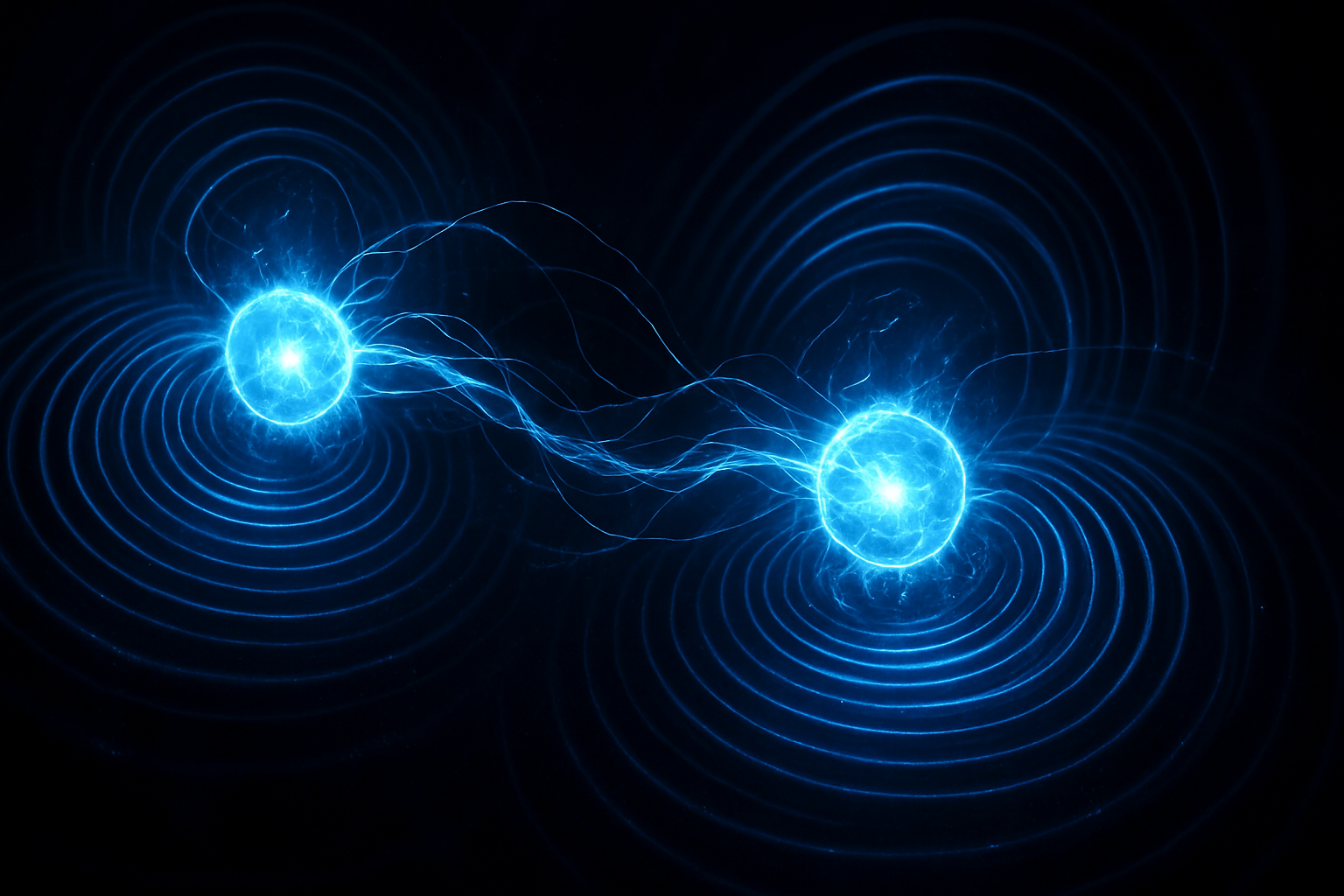
To understand why quantum entanglement matters for consciousness, we first need to sit with what it actually means physically. When two particles become entangled, they cease to have independent properties. They exist in a shared quantum state — a superposition of possibilities — until one is measured. At that moment, both particles collapse into definite states simultaneously, even if they are light-years apart. No signal travels between them. No known force connects them. The correlation simply is, woven into the fabric of reality itself.
The physicist John Bell proved mathematically in 1964 that no theory based on local hidden variables could account for these correlations. The universe, at its quantum foundation, appears to be fundamentally nonlocal. Information — or something deeper than information — operates outside the constraints of space and time that govern our everyday experience.
This is not mysticism. This is peer-reviewed physics. And it opens a door that many scientists are now willing to walk through: if nonlocality is a genuine feature of the physical universe, could biological systems — and specifically consciousness — exploit this feature in ways we are only beginning to understand?
"The day science begins to study non-physical phenomena, it will make more progress in one decade than in all the previous centuries of its existence." — Nikola Tesla
Quantum Biology and the Conscious Brain: The Evidence Building
For decades, the idea that quantum effects could survive in the warm, wet, noisy environment of the brain was dismissed. Quantum coherence, scientists argued, collapses almost instantly at biological temperatures. Then quantum biology arrived to challenge that assumption entirely.
In 2007, researchers at UC Berkeley published findings in Nature showing that photosynthesis in green plants exploits quantum coherence to transfer energy with near-perfect efficiency — something classical physics alone cannot explain. Birds navigate using a quantum compass in their eyes, where entangled electron pairs in cryptochrome proteins respond to Earth's magnetic field. Enzymes appear to use quantum tunneling to catalyze reactions at rates that defy classical chemistry.
Life, it seems, has learned to harness quantum effects. Why would the brain — the most complex biological structure in the known universe — be the exception?
Neuroscientist and anesthesiologist Stuart Hameroff, alongside mathematician Roger Penrose, proposed the Orchestrated Objective Reduction (Orch-OR) theory, suggesting that quantum computations inside microtubules — protein structures within neurons — are the physical substrate of conscious experience. More controversially, they suggest these processes may involve nonlocal quantum entanglement across neural networks and potentially beyond the brain itself. While Orch-OR remains debated, a 2014 study published in Physics of Life Reviews provided experimental evidence consistent with quantum vibrations in microtubules, lending the hypothesis new credibility.
The framework of quantum entanglement consciousness is no longer purely speculative. It stands at the edge of empirical science, waiting for the instruments precise enough to confirm what intuition — and some data — already suggests.
Mind Over Matter: How Consciousness May Influence Reality at a Distance
If consciousness involves quantum processes, and quantum processes are inherently nonlocal, then the mind's ability to influence reality at a distance — long the domain of prayer, intention, and healing traditions — gains a plausible physical mechanism.
The Princeton Engineering Anomalies Research (PEAR) laboratory conducted over 25 years of rigorous experiments showing that human operators could influence the output of random event generators (REGs) through focused intention alone — with results that defied chance at statistically significant levels. The Global Consciousness Project, a successor initiative, has documented correlations between major global events and the synchronized outputs of REGs placed around the world, suggesting that collective human attention may create measurable fluctuations in quantum randomness.
Healing intention studies are equally compelling. Researcher William Braud's meta-analysis of 655 sessions found significant evidence that one person's focused mental intention could influence another person's autonomic nervous system activity — even when sender and receiver were separated by distance. This is the signature pattern of nonlocal influence.
What these experiments suggest, taken together, is that consciousness does not end at the skull. It may extend, entangle, and influence — much like the particles whose behavior first revealed to us that the universe is not the mechanical, locally-bound system we imagined.
Practical Techniques: Working with Quantum Consciousness Now
You do not need a laboratory to begin exploring the principles of quantum entanglement consciousness in your own life. These practices are grounded in both ancient wisdom traditions and emerging science:
- Coherent Heart-Brain Entrainment: Research from the HeartMath Institute shows that sustained feelings of genuine appreciation or love create measurable electromagnetic coherence between heart and brain. This coherent state appears to enhance your capacity for intention and nonlocal influence. Practice generating a sincere feeling of gratitude while breathing rhythmically — 5 seconds in, 5 seconds out — for at least 10 minutes daily.
- Quantum Visualization with Embodied Feeling: Visualization alone is cognitive. Quantum intention requires the full-body feeling of the reality you wish to call in. Spend time each morning imagining your desired outcome while physically inhabiting the emotional state of its fulfillment. This is not wishful thinking — it is using your entire biological system as a coherent transmitter.
- Sound as an Entanglement Bridge: Specific frequencies, particularly those in the 528 Hz range often called the "Love Frequency," have been associated with DNA repair and heightened states of coherence in peer-reviewed bioacoustics research. Using tuning forks, singing bowls, or frequency-specific audio while setting clear intentions may amplify the coherence of your field. Quantress users report that consistent frequency-based practices dramatically deepen their sense of intentional connection and accelerate manifestation outcomes — a result consistent with what quantum biology predicts about coherent biological systems.
- Entanglement Meditation — The Two-Point Practice: Choose someone or something you wish to send healing or loving intention to. Spend two minutes creating a vivid, felt sense of connection — as if an invisible cord of light links your heart center to theirs. Hold that connection while radiating a specific emotion: compassion, love, healing. This practice mirrors the mechanics of entanglement: establishing a shared quantum state through conscious correlation.
- Stillness as Quantum Receptivity: Nonlocal information cannot be heard through mental noise. Daily meditation — even 15 minutes of silent, breath-centered awareness — reduces the neural entropy that drowns out subtle signals. EEG studies show that experienced meditators exhibit patterns of gamma-wave synchrony associated with states of heightened consciousness and integration, states that Penrose-Hameroff theory associates with maximum quantum coherence in microtubules.
Toward a New Science of Connected Consciousness
We stand at a remarkable threshold. The physics that once seemed to reduce reality to cold, mechanical interactions has revealed instead a universe that is fundamentally interconnected, responsive, and alive with nonlocal correlation. The science of quantum entanglement consciousness is converging with humanity's oldest spiritual understanding: that we are not isolated beings in a fragmented world, but nodes in an infinite web of relationship and meaning.
This does not ask you to abandon critical thinking. It asks you to expand it — to follow the evidence wherever it leads, even when it leads somewhere that feels like wonder. The quantum universe does not separate the observer from the observed. It does not separate your mind from the world your mind perceives. And it most certainly does not confine your influence to the reach of your physical hands.
Experiment with the practices above. Track your results. Approach your consciousness as the extraordinary quantum instrument it may actually be. The most important laboratory, it turns out, has always been the one you carry behind your eyes.