Quantum
The Quantum Field and Intention: How Focused Thought Sends Ripples Through the Fabric of Reality
Quantress · March 16, 2026
Quantum field theory suggests that every particle in the universe is embedded in an invisible, vibrating field of potential — and emerging research hints that conscious intention may directly interact with this field to shape physical outcomes. Discover the science behind intentional manifestation and why your focused thoughts may be far more powerful than you ever imagined.
Something extraordinary happens in the space between thought and matter. A scientist sits in a laboratory, measuring the behavior of subatomic particles, and notices something that shouldn't be possible according to classical physics: the act of observation itself appears to influence the outcome of the experiment. Across the world, a meditating monk generates measurable electromagnetic shifts in his surrounding environment. A mother, thousands of miles away, wakes at the exact moment her child is in danger. These phenomena sit at the uncomfortable edge of what mainstream science can fully explain — and they all point toward the same radical possibility: that consciousness and the quantum field are not separate systems, but intimately entangled ones.
The intersection of the quantum field and intention is no longer purely the domain of mystics and metaphysicians. It is becoming one of the most provocative frontiers in modern physics, consciousness studies, and biophysics. Understanding how focused thought may genuinely interact with the fabric of reality requires us to look carefully at what quantum field theory actually tells us — and then dare to follow that thread to its most profound implications.
What the Quantum Field Actually Is
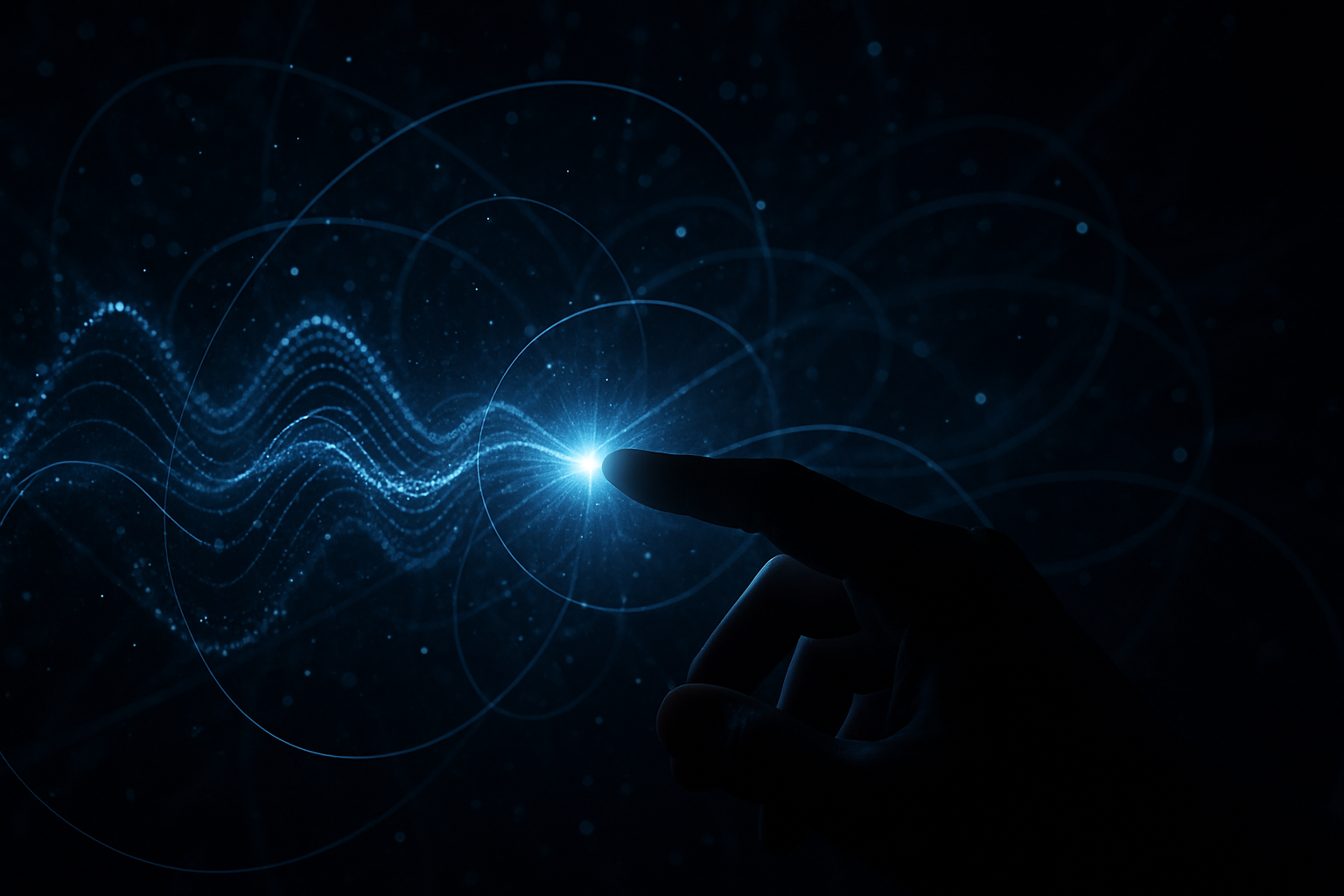
In classical physics, reality is made of solid objects moving through empty space. But quantum field theory — the most experimentally verified framework in the history of science — paints a radically different picture. According to this model, there are no solid particles at the fundamental level. Instead, the universe is composed of overlapping, vibrating fields that permeate all of space. What we perceive as particles — electrons, photons, quarks — are simply localized excitations, or ripples, within these fields.
This has a stunning implication: the universe is not a collection of things, but a vast interconnected web of vibrating potential. Everything that has ever existed, currently exists, or will exist emerges from this underlying field of possibility. The quantum vacuum — what physicists call the zero-point field — is not empty at all. It seethes with energy, fluctuation, and information at scales we are only beginning to measure.
Physicist David Bohm, one of the most visionary quantum theorists of the twentieth century, proposed the concept of the implicate order — a deeper level of reality in which everything is enfolded into everything else. Bohm believed that consciousness itself was not separate from this implicate order, but an expression of it.
"Ultimately, all moments are really one, therefore now is an eternity." — David Bohm, Wholeness and the Implicate Order
If Bohm was right, then the boundary between the observer and the observed — between mind and matter — may be far more permeable than our everyday experience suggests.
The Observer Effect and the Role of Intention
The famous double-slit experiment demonstrated something that physicists have never fully resolved: when electrons are observed passing through two slits, they behave like particles. When they are not observed, they behave like waves, passing through both slits simultaneously and creating an interference pattern. The act of measurement — of focused attention — collapses a wave of probability into a single, definite outcome.
This is where the relationship between the quantum field and intention becomes genuinely tantalizing. If attention can collapse quantum probability waves at the subatomic level, could sustained, coherent intention do something analogous at larger scales?
The Princeton Engineering Anomalies Research (PEAR) laboratory spent nearly three decades studying this question. Their findings — published across multiple peer-reviewed journals — suggested that human intention could produce statistically significant deviations in the output of random event generators (REGs), devices that produce truly random sequences of numbers. The effect was small but remarkably consistent across thousands of trials and hundreds of participants. Intention, it appeared, introduced a subtle but measurable order into random systems.
More recently, the Global Consciousness Project, a collaboration of researchers from multiple universities, has monitored a worldwide network of REGs for over two decades. During events of intense collective human focus — major disasters, global meditations, historic ceremonies — the network consistently shows non-random correlations that exceed chance by statistically significant margins. The data implies that coherent collective consciousness may create a kind of resonance within the quantum field itself.
How Focused Thought Creates Quantum Ripples
Understanding the mechanism by which intention might influence the quantum field requires moving beyond classical cause-and-effect thinking. Quantum systems operate through principles like non-locality (where entangled particles influence each other regardless of distance), superposition (where systems exist in multiple states simultaneously until observed), and coherence (where particles align into unified, ordered patterns).
Consciousness, particularly in deep meditative or intentional states, may generate neural coherence — synchronized brainwave activity — that resonates with the body's own biophoton field. Biophysicist Fritz-Albert Popp demonstrated that living cells emit and absorb coherent light at the quantum level, and that this biophoton communication may coordinate biological processes far faster than chemical signaling alone. When intention focuses this biophotonic activity into coherence, it may create a signal strong enough to interact meaningfully with ambient quantum fields.
The implications for the quantum field and intention practices are profound. A scattered, anxious mind generates incoherent electromagnetic noise. A focused, intentional mind generates coherent resonance. And coherence, in quantum systems, is what enables phase transitions — sudden shifts from one state of organization to another. This may be the physics underlying what spiritual traditions have long described as the power of prayer, visualization, and manifestation.
Practical Techniques for Intentional Field Interaction
Moving from theory to practice, there are several evidence-informed techniques you can begin using immediately to work consciously with the quantum field and intention:
- Coherent Heart-Brain Entrainment: Research from the HeartMath Institute shows that when you consciously generate feelings of appreciation or love while focusing on your heart center, your heart rhythm becomes coherent — and this coherence synchronizes with your brainwaves. Spend five minutes each morning deliberately cultivating the feeling of gratitude in your chest. This creates the internal coherence that quantum field interaction appears to require.
- Scalar Wave Visualization: Rather than visualizing your intention as a linear cause-and-effect sequence, try feeling it as an expanding wave moving outward in all directions simultaneously from your center — like a stone dropped in a still pond, but in three dimensions. This mirrors how quantum fields actually propagate, and may align your consciousness more naturally with field dynamics.
- Sound-Anchored Intention Setting: Specific frequencies, particularly those in the theta brainwave range (4–8 Hz), are associated with states of high suggestibility and quantum coherence in neural tissue. Using binaural beats or solfeggio frequencies during intentional visualization may amplify the signal. Quantress users consistently report deeper states of intentional clarity when pairing focused visualization with precisely tuned harmonic frequencies, noting what many describe as a felt sense of "locking in" to the field.
- Repetition Through Feeling, Not Force: Quantum probability shifts through resonance, not willpower. The key variable in intention work appears to be the emotional coherence and genuine belief behind the thought, not the mental effort applied. Practice returning to your intention with the quality of recognition — as if you are remembering something that is already true — rather than straining toward something distant.
Living as a Conscious Participant in the Field
Perhaps the most transformative shift the quantum field and intention paradigm invites us to make is this: to stop experiencing yourself as a passive observer of a fixed reality, and to begin living as an active participant in an unfolding field of possibility.
This is not magical thinking. It is, in many ways, more rigorous than the materialist worldview it challenges — because it demands that you take radical responsibility for the quality of consciousness you bring to each moment. Your attention is not neutral. Your intention is not inconsequential. Every focused thought you generate is a ripple sent through a medium that is far more responsive than the solid-seeming world around you suggests.
The mystics encoded this understanding in the language of their traditions. The physicists are encoding it in the mathematics of field equations. And somewhere in the resonance between those two languages, a new understanding of human potential is emerging — one in which the ancient wisdom that consciousness creates reality is not metaphor, but mechanism.
Begin simply. Choose one clear intention today. Cultivate coherence in your body through breath and heart focus. Feel the intention as already real, as a wave already moving outward through the field. Then release it — not in defeat, but in the trust that a coherent signal, once sent, continues to propagate. The universe, it turns out, has always been listening. The question has only ever been whether we were speaking clearly enough to be heard.