Quantum
The Quantum Observer Effect and Consciousness: How the Act of Observation Collapses Possibility Into Your Personal Reality
Quantress · March 27, 2026
At the heart of quantum physics lies a staggering implication: the act of observation itself shapes what becomes real. This article explores how the observer effect connects to consciousness and what it means for deliberate reality creation.
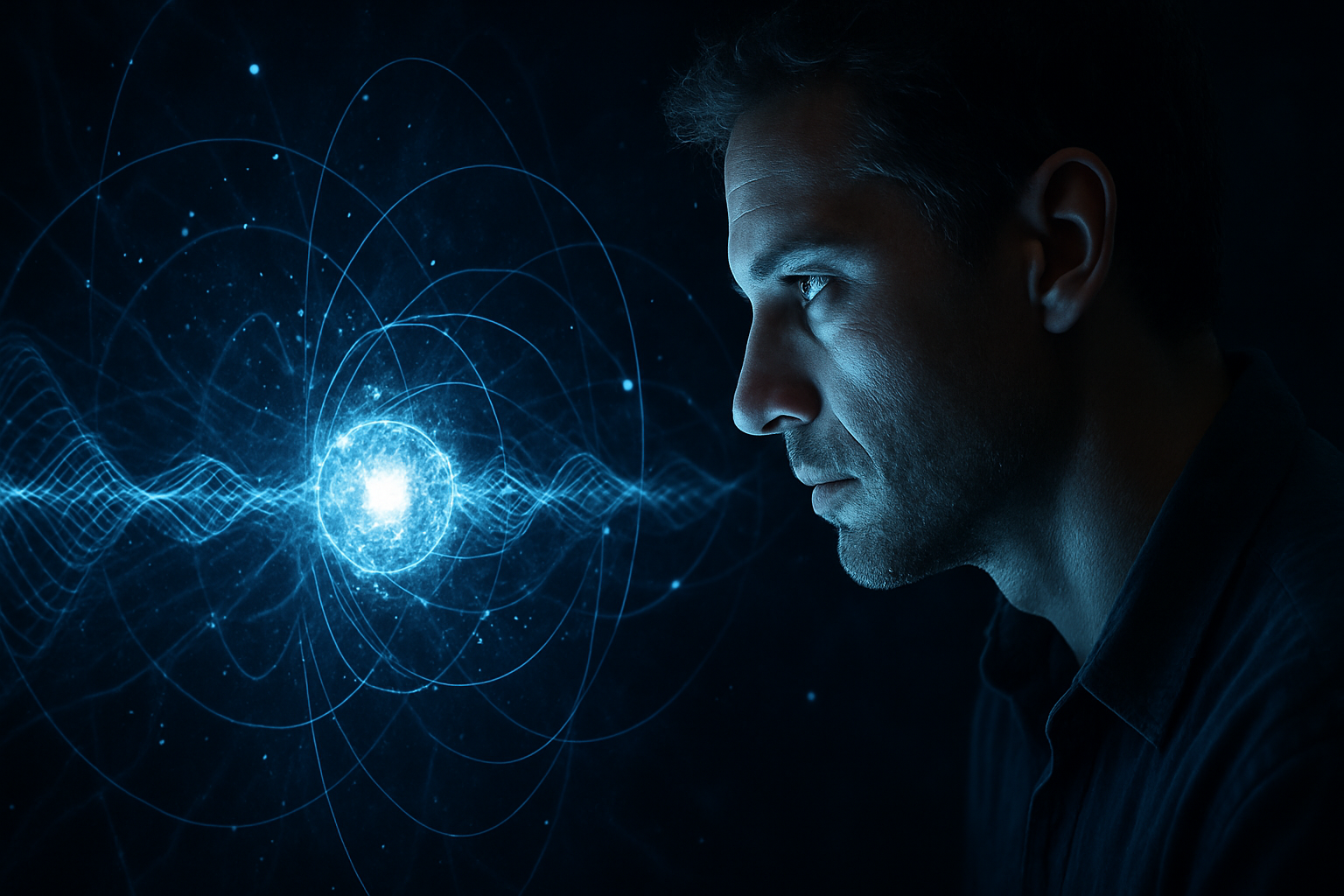
Something extraordinary happens the moment you look at a quantum particle. Before your observation, that particle exists in a state of pure potential — simultaneously here, there, and everywhere at once. The instant you measure it, that cloud of probability collapses into a single, definite location. This is not metaphor. This is peer-reviewed, laboratory-confirmed physics. And if consciousness plays a role in collapsing quantum possibility into physical reality at the subatomic scale, the implications for how you create your lived experience are nothing short of revolutionary. The intersection of quantum observer effect consciousness is one of the most fertile frontiers in modern science — and one of the most practical tools available to any serious seeker.
The Double-Slit Experiment: Where Physics Meets Mystery
The story begins in the early twentieth century with one of the most replicated and most unsettling experiments in the history of science. When physicists fired electrons through two parallel slits in a barrier, they expected to see two bands on a detector screen — the simple shadow of two openings. Instead, they found an interference pattern, the signature of a wave spreading through both slits simultaneously and interfering with itself. The electron, it seemed, was not a compact ball traveling through one slit. It was a probability wave passing through both.
Then researchers added a detector to determine which slit each electron actually passed through. The interference pattern vanished. The electrons began behaving like ordinary particles again. The act of measurement — of directed observation — had fundamentally altered the behavior of physical matter. This is the quantum observer effect: the process of gathering information about a system changes the state of that system in ways classical physics cannot explain.
Physicist John Wheeler took this further with his famous "delayed choice" experiments, demonstrating that the observer's decision about how to measure a particle could retroactively determine how that particle had behaved in the past. Wheeler concluded that we live in what he called a "participatory universe," one where conscious observers are not passive witnesses but active co-creators of physical events.
"We are participants in bringing into being not only the near and here, but the far away and long ago."
— John Archibald Wheeler, theoretical physicist
Consciousness as the Collapse Mechanism
The orthodox interpretation of quantum mechanics sidesteps the role of consciousness by attributing collapse to any physical measuring device, not exclusively to a conscious mind. But a growing body of theoretical and experimental work refuses to let the question rest there. The Copenhagen interpretation, championed by Niels Bohr, insisted that a quantum system does not have definite properties until it is observed. Eugene Wigner went further, arguing that consciousness itself was the only consistent candidate for the collapse mechanism — a position now called the "consciousness causes collapse" hypothesis.
More recently, researchers like Roger Penrose and anesthesiologist Stuart Hameroff have proposed the Orchestrated Objective Reduction (Orch-OR) theory, suggesting that quantum processes occurring inside neuronal microtubules are the physical substrate of conscious experience. While Orch-OR remains contested, it has attracted serious peer review and has been partially supported by findings published in Physics of Life Reviews (2014), where hundreds of scientists offered commentary on its plausibility. The idea that quantum observer effect consciousness is not just a philosophical curiosity but a mechanistic reality is gaining traction in mainstream scientific circles.
What this means practically is profound: if consciousness is not merely a passive recorder of a pre-existing reality but an active participant in selecting which quantum possibility crystallizes into experience, then the quality, focus, and emotional tone of your awareness become extraordinarily important variables in the architecture of your life.
Observation as a Spiritual Practice: Collapsing Reality Intentionally
Ancient contemplative traditions arrived at remarkably similar conclusions through entirely different methodologies. Vedantic philosophy describes the universe as Brahman — pure, undifferentiated consciousness from which all form arises through the act of focused attention. Buddhist phenomenology has long taught that the observer and the observed are not truly separate, and that the quality of attention shapes the arising of experience. These are not poetic approximations. They are sophisticated maps of the same territory quantum physicists are now charting with mathematics.
Understanding quantum observer effect consciousness as a practical framework invites us to ask a transformative question: what are you collapsing with your attention right now?
Every moment, you are surrounded by a field of quantum possibility — possibilities for how an interaction might unfold, how your body might feel, how a creative project might develop. The focus and emotional charge of your observation acts as a selection mechanism, preferentially collapsing certain outcomes over others. This is not magical thinking layered over physics; it is a reasonable extension of what the physics itself suggests when taken seriously.
Here are concrete practices you can begin today:
- Intentional Morning Observation: Before checking your phone or engaging with the external world, spend five minutes in a quiet, receptive state. Consciously "observe" the day ahead as you wish it to feel — not as a daydream, but as a deliberate act of perceptual focus. Hold the emotional resonance of the outcome you want. You are, in effect, placing your observational weight on a specific region of the probability space.
- Quantum Witnessing Meditation: Sit in stillness and practice observing your thoughts without labeling them as good or bad. This trains the faculty of "pure observation" — awareness without reactive collapse. Many seasoned meditators report that this practice eventually creates a felt sense of the open, undifferentiated possibility field that quantum mechanics describes mathematically.
- Charged Attention Journaling: Write about a desired outcome using present-tense, emotionally vivid language. The key is not to manufacture false positivity but to genuinely feel into the reality as if your observation has already collapsed it into being. Neuroscience supports this: mirror neurons and the default mode network respond similarly to vividly imagined and physically experienced events.
- Sound as Observer Amplifier: Specific sound frequencies appear to modulate brainwave states in ways that prime the nervous system for heightened, coherent observation. Research on binaural beats published in Frontiers in Human Neuroscience (2017) demonstrated measurable shifts in EEG activity associated with altered states of focused awareness — precisely the states where intentional observation carries the most momentum.
Frequency, Coherence, and the Amplified Observer
Not all observation is equal. A distracted, anxious, or fragmented mind collapses possibility in equally distracted, anxious, and fragmented ways. The quality of your consciousness as an observer determines the coherence of what you collapse into reality. This is why frequency work — using sound, breathwork, and meditative practice to elevate and stabilize your state of consciousness — is not peripheral to manifestation but central to it.
Coherent brain states, characterized by synchronized gamma and theta wave activity, have been associated with heightened creativity, intuitive insight, and what researchers at the HeartMath Institute describe as "heart-brain coherence" — a measurable state of psychophysiological synchronization linked to positive emotional resonance and improved intuitive decision-making. When your internal observer is coherent, you bring a kind of focused quantum weight to your attention that incoherent, scattered awareness simply cannot match.
This is precisely why sound-based tools have become so central to serious consciousness work. Quantress users report that working with precisely tuned resonance frequencies during intentional observation practices dramatically deepens their ability to sustain the kind of coherent, emotionally charged attention that the quantum observer model describes as generative. Tools like Quantress leverage the relationship between acoustic frequency, brainwave entrainment, and conscious intention to help practitioners become more powerful, more deliberate observers of their own reality fields.
Becoming a Conscious Architect of Your Reality
The quantum observer effect is not a loophole or a metaphor borrowed from physics to dress up wish fulfillment. It is a genuine and deeply strange feature of the universe we actually inhabit — one that places consciousness at the center of physical reality rather than at its periphery. The invitation is both humbling and electrifying: you are not a passive spectator watching a fixed movie called your life. You are the observer whose act of looking participates in writing the next scene.
Begin experimenting. Bring deliberate, emotionally coherent attention to the possibilities you most wish to see crystallize. Practice the disciplines that refine and amplify the quality of your observation. Notice, over days and weeks, whether the reality that collapses around you begins to reflect the frequency of the observer you are becoming. The laboratory is your life. The instrument is your consciousness. And the quantum universe, it turns out, has been waiting for you to take your role seriously.