Quantum
Quantum Tunneling and Consciousness: How Subatomic Barrier-Breaking May Explain the Mind's Ability to Leap Beyond Perceived Limits
Quantress · April 6, 2026
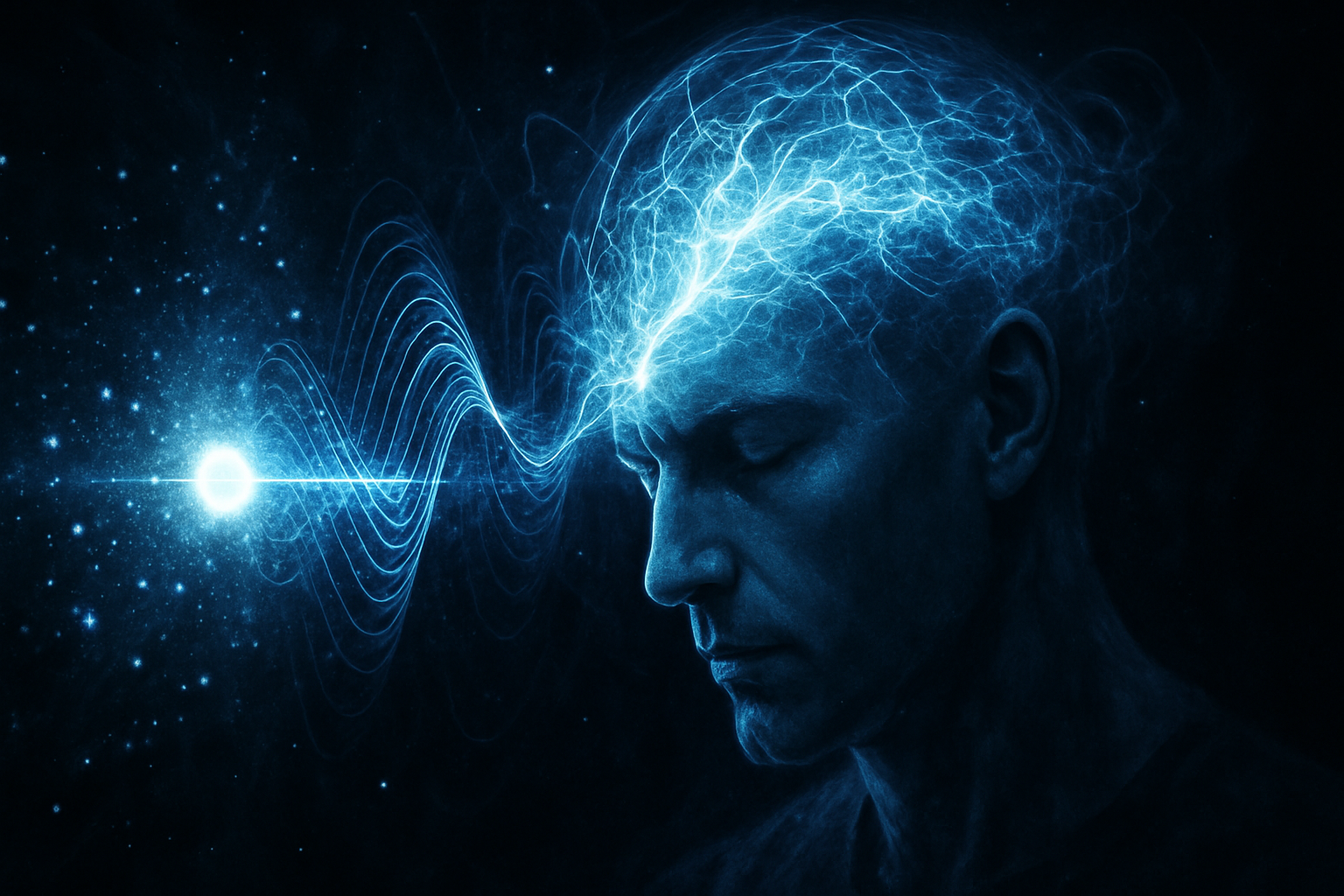
Quantum tunneling allows particles to pass through barriers that classical physics says are impossible to cross — and new theories suggest consciousness may operate by the same rules. This article explores how understanding tunneling at the biological level reframes the mind's capacity to bypass limiting beliefs and manifest outcomes that defy logical expectation.
There is a moment — perhaps you've felt it — when a problem you've been wrestling with for days suddenly dissolves. Not through logic, not through effort, but through something that feels almost inexplicable. An insight arrives whole, a barrier disappears, and your mind lands on the other side of an obstacle it could not rationally have crossed. Science has long struggled to explain these leaps. But deep inside the architecture of matter itself, a phenomenon called quantum tunneling has been quietly doing something remarkably similar — and it may hold the key to understanding how consciousness transcends its perceived limits.
What Quantum Tunneling Actually Is (And Why It Defies Classical Logic)
In classical physics, a particle that lacks the energy to overcome a barrier simply cannot cross it. Full stop. But at the quantum level, reality operates by a different rulebook. Quantum tunneling describes the experimentally verified phenomenon in which a subatomic particle — an electron, a proton, even an entire hydrogen atom — passes through an energy barrier rather than over it, despite not possessing sufficient energy to do so by classical standards.
This isn't metaphor or theoretical speculation. Quantum tunneling is the mechanism that powers nuclear fusion in the sun, drives the biochemistry of enzyme catalysis, and enables the semiconductor transistors inside every device you own. Without it, you would not be reading these words. The universe, at its most foundational level, is built on the principle that barriers are not absolute.
What makes this relevant to consciousness is a growing body of research suggesting that quantum-scale processes may be deeply implicated in biological and neurological function. The emerging field of quantum biology has documented tunneling in photosynthesis, bird navigation via cryptochrome proteins, and — critically — in the proton transfers that regulate DNA mutation rates. Researchers at the University of Surrey, building on earlier work by Jim Al-Khalili and Johnjoe McFadden, have published findings indicating that quantum coherence and tunneling effects persist in warm, wet biological systems far longer than classical physics would predict.
"The universe is not only queerer than we suppose, but queerer than we can suppose."
— J.B.S. Haldane, geneticist and polymath
The question that sits at the thrilling intersection of neuroscience and quantum physics is this: if tunneling operates within the biochemical machinery of life itself, could it also be operating within the substrate of conscious experience? The study of quantum tunneling consciousness is still young, contested, and extraordinary — which is precisely why it deserves our serious, open-minded attention.
The Quantum Mind Hypothesis: From Penrose to Pahnke
The idea that quantum mechanics plays a functional role in consciousness gained significant traction through the Orchestrated Objective Reduction (Orch-OR) theory, proposed by physicist Sir Roger Penrose and anesthesiologist Stuart Hameroff in the 1990s. Their model suggests that microtubules — protein structures inside neurons — serve as sites for quantum computation, including tunneling events, that give rise to moments of conscious awareness.
While Orch-OR remains controversial and not universally accepted, a 2022 study published in the journal Physics of Life Reviews reported experimental evidence of quantum vibrations in microtubules consistent with the predictions of the model, reigniting serious academic debate. Hameroff himself has described consciousness as "sequences of quantum computations" that could, in principle, interface with the deeper fabric of spacetime.
What this means practically is profound: if consciousness is partially grounded in quantum processes, then its capacity to behave like a quantum system — nonlocally, nonlinearly, leaping across apparent barriers — is not poetic license. It is physical possibility. The mind may literally have built-in mechanisms for tunneling through cognitive, emotional, and perceptual walls.
- Cognitive tunneling: The sudden breakthrough insight that bypasses linear reasoning — what researchers call "aha moments" — may correspond to quantum-coherent state transitions in neural networks.
- Emotional tunneling: Trauma release and spontaneous healing shifts that occur without conscious processing may reflect quantum-scale reorganization in cellular memory.
- Perceptual tunneling: States of expanded awareness documented in meditation research, where ordinary cognitive barriers dissolve, may involve genuine quantum decoherence shifts at the neurological level.
Sound, Frequency, and Lowering the Quantum Barrier
In quantum mechanics, the probability of tunneling increases as the barrier height decreases and as the particle's wave function becomes more extended — more spread out, more coherent, more resonant with the space it seeks to cross. This is not merely a technical detail. It is an invitation.
If we treat consciousness as a wave function — and there are serious theoretical frameworks, including those derived from David Bohm's implicate order and Karl Pribram's holonomic brain theory, that support this framing — then the question becomes: what conditions allow the conscious wave function to extend, cohere, and tunnel through limiting states?
The answer, supported by decades of neuroscience research, is resonance. Specifically, sound and vibrational frequency have been shown to alter brainwave states in measurable ways. A landmark study by researchers at Stanford's Center for Computer Research in Music and Acoustics demonstrated that binaural beat entrainment could reliably shift neural oscillations from beta (effortful thinking) to theta (deep creative and integrative states) within minutes. Theta states, interestingly, are associated with the exact type of sudden insight and barrier-dissolving cognition that mirrors quantum tunneling behavior.
Practices rooted in sound healing — including Tibetan singing bowls, tuning fork therapy, and structured tonal meditation — may be operating as quantum-coherence amplifiers: reducing the "barrier height" of limiting mental states and increasing the probability that consciousness tunnels through into expanded awareness. Quantress users report that consistent engagement with resonance-based audio practices correlates with measurable improvements in creative problem-solving, emotional processing speed, and states that they describe as "clarity beyond thinking."
Practical Techniques for Inducing Quantum-Leap States
You do not need a laboratory to begin working with these principles. The following practices are grounded in both scientific understanding and contemplative tradition, designed to help you intentionally cultivate the internal conditions that favor consciousness tunneling.
- Theta threshold meditation (10–20 minutes): Use binaural beats in the 4–7 Hz range through stereo headphones while maintaining a relaxed, unfocused attention. Do not try to solve a problem. Simply hold a question lightly at the edges of awareness and allow the resonance to do its work. This mirrors the incubation phase of insight as described in research by cognitive neuroscientist John Kounios.
- Coherent breathing with tonal anchoring: Breathe at 5–6 breaths per minute (approximately 5 seconds in, 5 seconds out) while humming a single sustained tone on each exhale. This technique simultaneously activates vagal coherence and creates internal vibrational resonance. Studies on heart rate variability confirm that coherent breathing shifts autonomic nervous system balance in ways that reduce cognitive rigidity.
- Barrier visualization and quantum release: In a relaxed state, vividly imagine the limiting belief or problem as a physical wall. Then, rather than trying to climb or break it, visualize yourself becoming diffuse — wave-like, spread across the barrier — and simply appearing on the other side, as quantum particles genuinely do. The nervous system responds to vivid mental simulation in ways that parallel actual experience, and this practice builds a somatic expectation of effortless passage.
- Post-session journaling: Immediately after any resonance practice, write without editing for three minutes. Quantum insights are fragile and fast-decohering. Capturing them in language before the analytical mind re-asserts its barrier is essential.
Living at the Quantum Edge of Mind
The science of quantum tunneling consciousness is not yet complete. It may never be, in the way that living experience resists final reduction to equation. But the direction of the evidence — from quantum biology to neuroscience to the phenomenology of insight and expanded states — points consistently toward a remarkable possibility: that the mind is not fundamentally bounded by the walls it perceives.
The barriers that feel most solid — the limiting beliefs, the calcified identities, the problems that seem impenetrable — may be precisely the kind of structures that a coherent, resonant consciousness can tunnel through. Not by force. Not by logic alone. But by becoming wave-like enough, still enough, resonant enough, to slip through the spaces that classical thinking cannot see.
This is what the great contemplative traditions have always known, expressed now in the language of quantum mechanics. The path beyond your limits may not go over them or around them. It may pass, quietly and completely, right through.
Begin tonight. Choose one technique. Hold your question gently. And let the wave function of your awareness find its way to the other side.