Manifestation
Sleep Manifestation: How Hypnagogic States Between Waking and Sleep Prime the Subconscious for Accelerated Reality Formation
Quantress · May 2, 2026
The hypnagogic threshold between waking and sleep represents one of the most neurologically receptive windows for subconscious reprogramming. This article examines how intentional use of this transitional state can dramatically compress the timeline between intention and manifestation.
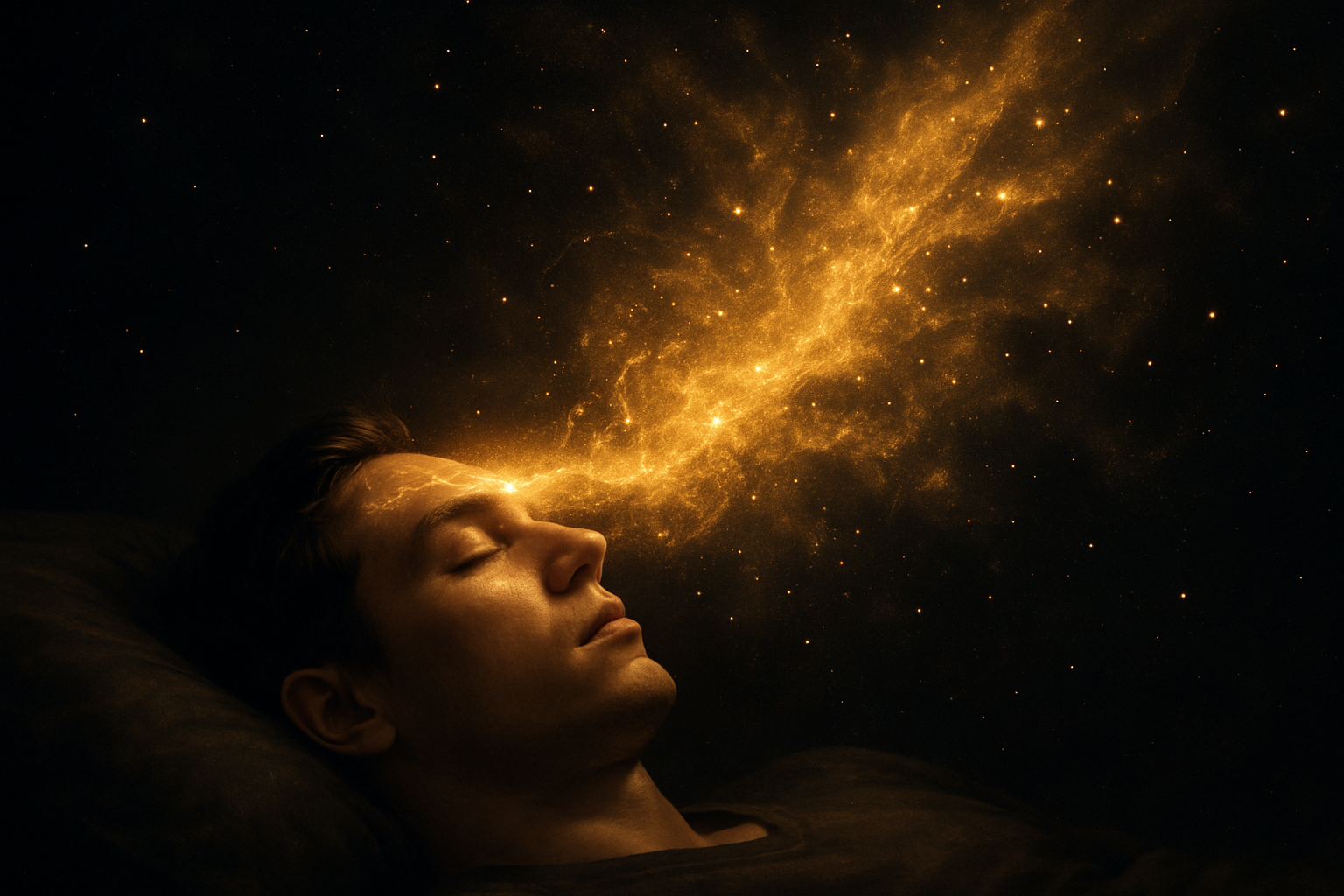
Every night, without exception, you cross a threshold that scientists still cannot fully explain. In the minutes between waking consciousness and deep sleep, your brain enters one of the most neurologically extraordinary states known to exist — a liminal zone where the rigid architecture of rational thought begins to dissolve, and something far more fluid and receptive emerges. This is the hypnagogic state, and for those who understand how to work with it intentionally, it represents one of the most powerful entry points for sleep manifestation available to human beings.
The science here is not speculative. EEG research consistently shows that as the brain transitions from waking beta waves into sleep, it passes through a distinct theta-dominant phase (4–8 Hz) characterized by vivid imagery, loosened associative logic, and a dramatic reduction in the critical filtering function of the prefrontal cortex. In plain terms: the inner editor goes offline, and the subconscious becomes radically accessible. What you plant in this fertile window does not simply get processed — it gets integrated at a foundational level of neural architecture.
The Neuroscience of the Hypnagogic Threshold
Research published in the journal Consciousness and Cognition has documented the hypnagogic state as a distinct form of consciousness — not simply a degraded version of waking awareness, but a qualitatively different mode of information processing. During this phase, the default mode network (DMN), associated with self-referential thought and autobiographical memory, shifts its activity patterns in ways that parallel the neural signatures observed during deep meditative states and certain psychedelic experiences.
What this means for sleep manifestation is profound. The subconscious mind, which governs approximately 95% of our behavior according to cognitive neuroscientist Dr. Bruce Lipton's research on cellular biology and belief systems, operates primarily through imagery, emotion, and pattern recognition — not language. The hypnagogic state speaks exactly that language. The symbolic, sensory-rich hallucinations that arise naturally in this phase are not noise. They are the subconscious mind's native dialect, and when you learn to introduce intentional imagery and emotional states into this window, you are effectively programming in the subconscious's own code.
"The intuitive mind is a sacred gift and the rational mind is a faithful servant. We have created a society that honors the servant and has forgotten the gift."
— Albert Einstein
Einstein's insight takes on new precision when viewed through the lens of hypnagogic neuroscience. The rational mind — that faithful servant — is precisely what quiets during the sleep-onset transition. What remains is something older, more connected, and staggeringly more powerful in its capacity to reshape the neural templates that determine what we perceive as possible in our waking lives.
Why This Window Accelerates Reality Formation
Classical manifestation frameworks have long recognized the importance of the sleep boundary. Neville Goddard, the 20th-century mystic whose teachings have experienced a remarkable renaissance in consciousness communities, built his entire practice around what he called the "state akin to sleep" — explicitly identifying the hypnagogic threshold as the optimal moment to impress a desired reality onto the subconscious. What is extraordinary is how precisely modern neuroscience validates this intuition.
When theta brainwaves dominate, neuroplasticity — the brain's capacity to form new synaptic connections — is significantly enhanced. A 2019 study from the University of California, Berkeley, on memory consolidation during sleep onset demonstrated that information introduced just before and during the early stages of sleep is disproportionately likely to be encoded into long-term memory networks. The brain is not simply resting; it is actively reorganizing its model of reality.
From a quantum consciousness perspective — drawing on frameworks proposed by physicists like Roger Penrose and Stuart Hameroff in their Orchestrated Objective Reduction (Orch-OR) theory — consciousness itself may be entangled with quantum processes at the microtubular level of neurons. During hypnagogic states, when classical cognitive control relaxes, these quantum-coherent processes may operate with less interference, creating conditions where conscious intention has a more direct influence on the probabilistic landscape of neural — and perhaps physical — reality formation. This remains a frontier hypothesis, but it is one taken seriously in serious scientific circles.
The practical implication is straightforward: the hypnagogic state is not merely a relaxation opportunity. It is a quantum-plastic window in which sleep manifestation becomes accelerated through a convergence of reduced critical resistance, enhanced neuroplasticity, and heightened subconscious receptivity.
Four Techniques to Activate Hypnagogic Sleep Manifestation
Understanding the science is one thing. Using it is another. The following techniques can be implemented tonight:
- The Sensory Scene Method: As you lie down and feel the first waves of drowsiness arrive, do not visualize your desired outcome as a distant movie. Instead, construct a single, emotionally charged scene that implies your desire is already fulfilled. Feel the texture of the sheets if you imagine yourself in a new home. Hear the specific quality of silence in the office you desire. The subconscious responds to sensory specificity far more powerfully than abstract affirmation. Hold this scene loosely — not with effortful concentration but with soft, drowsy attention.
- The Theta Anchoring Breath: Before introducing any intention, use a 4-7-8 breathing pattern (inhale for 4 counts, hold for 7, exhale for 8) for three complete cycles. This parasympathetic activation reliably accelerates theta wave emergence, effectively deepening the hypnagogic channel before you begin your sleep manifestation practice.
- The Feeling-First Protocol: Rather than leading with imagery, begin by summoning the emotional state of your fulfilled desire — gratitude, expansion, safety, joy, or whatever resonates — and allow imagery to arise spontaneously around that emotional core. This mirrors how the subconscious actually processes experience: emotion first, narrative second.
- Hypnagogic Sound Layering: Binaural beats or isochronic tones tuned to 5–7 Hz (theta range) listened to through headphones as you enter sleep onset can measurably accelerate and deepen the hypnagogic state. This is not anecdotal — a meta-analysis published in Psychological Bulletin found significant effects of binaural beat stimulation on self-reported altered states and relaxation depth. Pairing specific frequencies with your intentional practice creates a powerful, reproducible protocol.
Common Mistakes That Collapse the Manifestation Window
Most people inadvertently sabotage their hypnagogic potential through habitual patterns that occur in the final hour before sleep. Screen exposure — particularly the blue-light-driven cortisol spike from devices — actively suppresses melatonin and delays the onset of theta dominance, compressing or eliminating the hypnagogic window before it can be used intentionally. Emotionally activating content (news, conflict, social media comparison spirals) primes the amygdala in ways that keep the prefrontal cortex's critical function elevated precisely when you need it to soften.
Equally important is the quality of your last conscious thought. Research on memory consolidation consistently demonstrates that the emotional valence of information processed immediately before sleep disproportionately influences what gets encoded during the night. Anxiety and lack-focused thinking before sleep is not simply unpleasant — it is actively programming the subconscious with the very patterns that contradict your desires.
Quantress users who combine theta-frequency sound protocols with the Feeling-First technique consistently report not only deeper sleep quality but a measurable increase in what researchers call "goal-relevant dreaming" — dreams in which the content directly reflects and reinforces desired outcomes, suggesting that intentional hypnagogic priming cascades through all subsequent sleep stages.
The Edge of Sleep Is the Edge of Creation
There is something quietly revolutionary about recognizing that the most powerful manifestation practice available to you requires no special equipment, no years of meditative training, and no radical lifestyle restructuring. It asks only that you become conscious at the threshold you already cross every single night — that you arrive at the edge of sleep with intention rather than by accident.
The hypnagogic state is a reminder that consciousness is not a fixed, singular mode of being. It is a spectrum, and different points on that spectrum have different relationships to the architecture of perceived reality. When you understand that the sleeping mind is not an absence of consciousness but a different expression of it — one that is closer to the generative substrate of experience — sleep manifestation stops being mystical metaphor and becomes applied neuroscience.
Begin tonight. Breathe slowly. Let drowsiness arrive. And just before the world goes dark, hold the feeling of what you are becoming — not as a wish cast into the void, but as a signal delivered directly into the neural soil where tomorrow's reality is already being grown.