Quantum
Observer Effect and Consciousness: How the Act of Watching Collapses Quantum Possibility Into Physical Reality
Quantress · August 7, 2026
Quantum mechanics reveals that particles exist in superposition until observed — and some researchers believe conscious attention is the collapsing force. This article unpacks what the observer effect actually means for mind, intention, and the mechanics of reality creation.
You have done the meditation. You have repeated the affirmations. You have set the intentions and visualized the outcomes. And yet, weeks or months later, the same mental fog returns, the same anxious loops replay, and the changes you were certain were coming somehow never quite land. The frustration is not a failure of effort — it is a failure of mechanism. Without understanding observer effect consciousness at the level of actual physics, most practices remain surface rituals that never reach the substrate where change is possible. The cost of staying in that loop is not just wasted mornings. It is years of compounding cognitive drift, decisions made from scattered attention, and a slow erosion of the certainty that change is even real. The outcome on the other side is not mystical: it is a nervous system that responds differently to the same stimuli because the underlying probability architecture has genuinely shifted. That shift begins with understanding what observation actually does — and how conscious attention collapses possibility into measurable physical structure.
What the Observer Effect Actually Means (It Is Not What Pop Science Says)
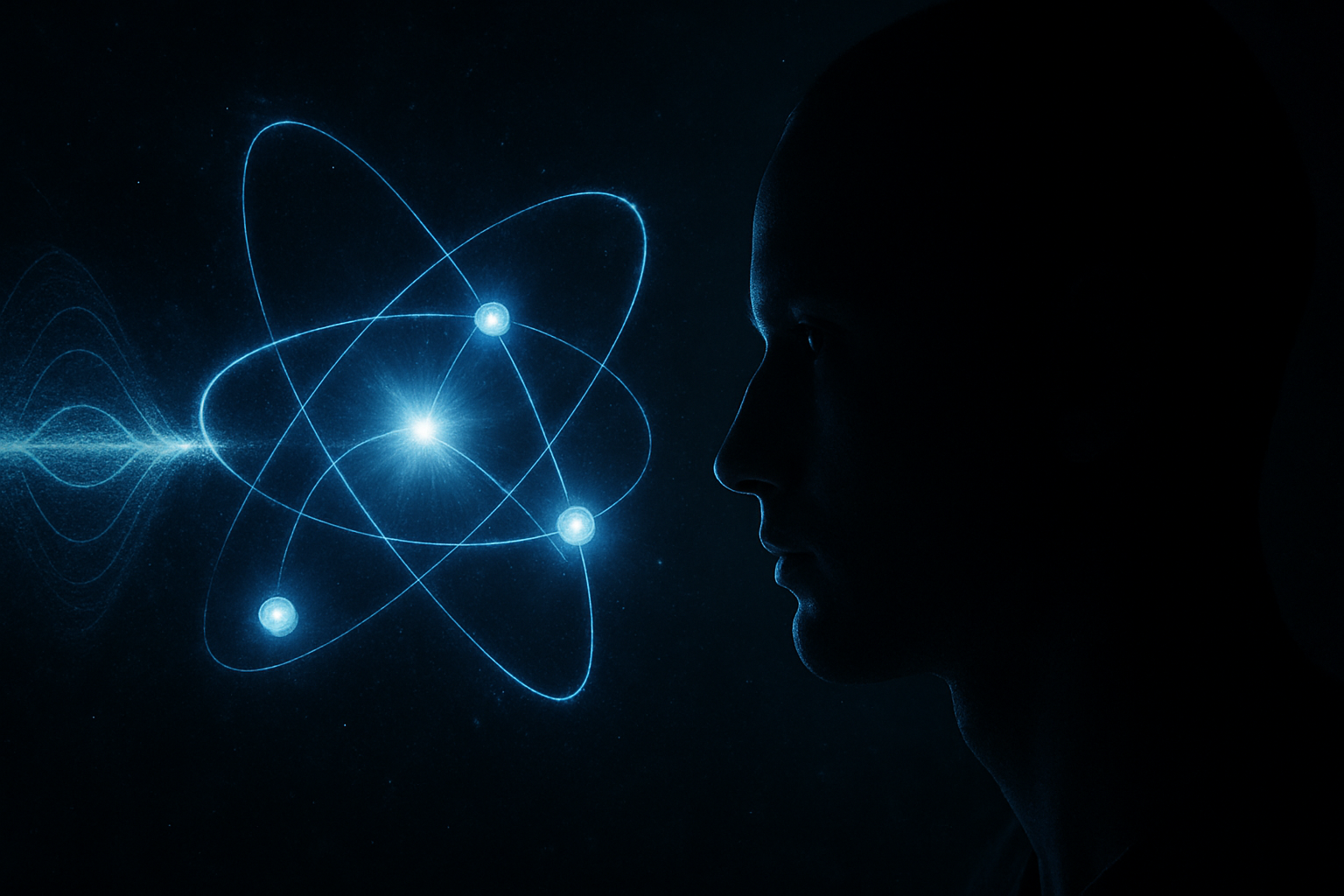
The term "observer effect" gets borrowed loosely in wellness content, usually to mean something like "your positive gaze attracts good things." That framing skips the actual physics entirely. In quantum mechanics, the observer effect describes a precise and reproducible phenomenon: a quantum system exists in a superposition of multiple possible states simultaneously until the moment of measurement, at which point the wave function collapses into a single definite outcome. The double-slit experiment — one of the most replicated experiments in physics — demonstrates this with electrons. When no detection apparatus is present, electrons pass through both slits simultaneously and create an interference pattern on the back wall. The moment a detector is placed to determine which slit each electron passes through, the interference pattern vanishes. The electrons behave as particles, not waves. The act of measurement changes the physical result.
The critical question for consciousness research is this: what counts as an "observer"? Early Copenhagen interpretation theorists, including Niels Bohr and Werner Heisenberg, were notably ambiguous about whether physical apparatus alone constituted measurement or whether something like awareness was implicated. That ambiguity is not resolved — and it is precisely the opening through which observer effect consciousness research has developed into a serious field. The implications for how you direct attention are not metaphorical. They are structural.
The Neuroscience and Quantum Biology Behind Conscious Observation
Two research threads are relevant here and neither requires you to accept anything on faith.
First, the Penrose-Hameroff Orchestrated Objective Reduction (Orch-OR) model. Physicist Roger Penrose and anesthesiologist Stuart Hameroff proposed that consciousness arises from quantum computations occurring inside microtubules — protein structures within neurons. Their model suggests that conscious moments correspond to moments of wave function collapse inside the brain itself. If accurate, the brain is not merely a classical information processor that receives sensory data and constructs experience after the fact. It is a quantum-sensitive instrument whose internal state participates in the resolution of probability. Research by Anirban Bandyopadhyay and colleagues at the National Institute for Materials Science in Japan has provided supporting evidence that microtubules do support quantum vibrations at biologically relevant timescales, lending the model considerably more traction than it held a decade ago. This connects directly to broader questions of how synchronized quantum states amplify conscious intention.
Second, the HeartMath Institute data on coherence and perception. Researcher Rollin McCraty and colleagues at the HeartMath Institute have demonstrated that the heart generates an electromagnetic field measurable several feet from the body, and that this field shifts measurably depending on the emotional state of the individual. More striking, their studies on cardiac coherence show that when heart rate variability enters a coherent rhythm — achievable through specific breathing and attentional practices — participants demonstrate improved performance on tasks requiring accurate perception and decision-making. This is not a metaphysical claim. It is a measurable physiological shift in how the sensing apparatus of the body is calibrated. The quality of your internal state changes what you are capable of observing — and therefore, according to the physics above, what you collapse from possibility into actuality.
"The universe is not only queerer than we suppose, but queerer than we can suppose."
— J.B.S. Haldane, British geneticist and evolutionary biologist
The deeper research thread on how probability layers respond to focused attention suggests that the quality of observation — not merely its presence — determines the resolution of outcomes. This is the lever that most practices miss entirely.
The Practice: Directed Observation as a Physical Act
Understanding the mechanism changes what you actually do during a practice session. Most meditation instructions focus on relaxing or emptying the mind. That is useful, but incomplete. What the observer effect consciousness framework adds is directionality: the quality of your observational state matters as much as its presence. A scattered, anxious observer collapses a different range of possibilities than a coherent, focused one — not because of magical thinking, but because the internal physiological state shapes the sensitivity and resolution of the measurement instrument (your nervous system).
The shortest effective path to a coherent observational state involves three sequential elements: physiological regulation first, then attentional narrowing, then directed observation of a specific internal or external target. Skipping straight to visualization without establishing coherence first is why most manifestation practices feel thin. You are attempting high-resolution observation with a poorly calibrated instrument. The breathing protocols used in HeartMath research — inhale for five seconds, exhale for five seconds, with attention placed at the center of the chest — produce measurable cardiac coherence within three to five minutes and do not require any prior meditation experience.
The relationship between this practice and the mind's capacity to move through apparent resistance becomes clearer once you have experienced even a single session of genuine coherence: problems that felt structurally fixed begin to present edges and openings that were invisible from a dysregulated state.
What to Skip and the Mistake That Costs You the Most
The single most common error in applying observer effect consciousness principles is conflating duration with quality. Forty-five minutes of distracted visualization produces less structural change than eight minutes of coherent, precisely directed observation. Longer sessions without physiological coherence are not a stronger dose — they are the same ineffective dose repeated. Skip extended open-monitoring meditation for this specific purpose. Skip passive affirmation repetition. Both may have other benefits, but neither addresses the calibration of the observational instrument, which is the actual variable you are trying to change.
The second error is observing outcomes without specificity. The wave function collapse analogy is instructive here: a detector that cannot distinguish between two states produces no collapse. Observation needs resolution. When directing attention toward an intended state, sensory specificity — temperature, texture, sound, posture — produces measurably stronger neural encoding than abstract concepts like "abundance" or "clarity." This connects to research on how focused thought sends structured signals through shared fields, rather than diffuse noise.
Try This in the Next 10 Minutes
- Sit in a chair with your spine upright and your feet flat on the floor. Close your eyes.
- Breathe in through your nose for a count of five. Breathe out through your mouth for a count of five. Place your attention at the center of your chest, not your head. Repeat this cycle for three minutes without altering the rhythm.
- Once you feel the breath settle — slightly slower, slightly easier — introduce a single specific sensory image of the state you want to inhabit. Not a goal. A state. What does the air feel like in that life? What sounds are present? What is the quality of light?
- Hold that sensory field with relaxed attention for four minutes. If the mind wanders, return to the breath cycle for two breaths, then return to the image. Do not force. Coherent observation is light-touch, not effortful grip.
- Before opening your eyes, spend thirty seconds simply noticing what has changed in your body temperature, breath rate, or sense of space in the chest. This is data, not evaluation.
Quantress encodes these coherence-first, observation-directed principles into structured audio sessions calibrated to specific intention states, so you are not assembling the breathing protocol, the attentional anchor, and the sensory scaffolding manually each time. The sessions are built around the same physiological sequencing described above, with frequency layers that support the cardiac coherence window before directing attention — particularly useful if you find the first two minutes of any practice the hardest to sustain. You can explore how observation shapes personal reality across different life domains through the Quantress session library.
The physics is real. The instrument is your nervous system. And the next ten minutes are enough to begin recalibrating it — not toward a vague feeling of hope, but toward the coherent, high-resolution observational state from which genuine change in perception, decision, and daily reality actually becomes available.